
What Is Air Conditioning Ductwork and How Does It Work?
Air conditioning ductwork is the network of insulated channels that carries conditioned air from a central indoor unit to every room in your home. If you've ever wondered how a single system can cool a five-bedroom Federation home in Wahroonga or heat every floor of a multi-storey terrace in Balmain, the answer is almost always a well-designed ducted air conditioning system with a properly planned duct layout.
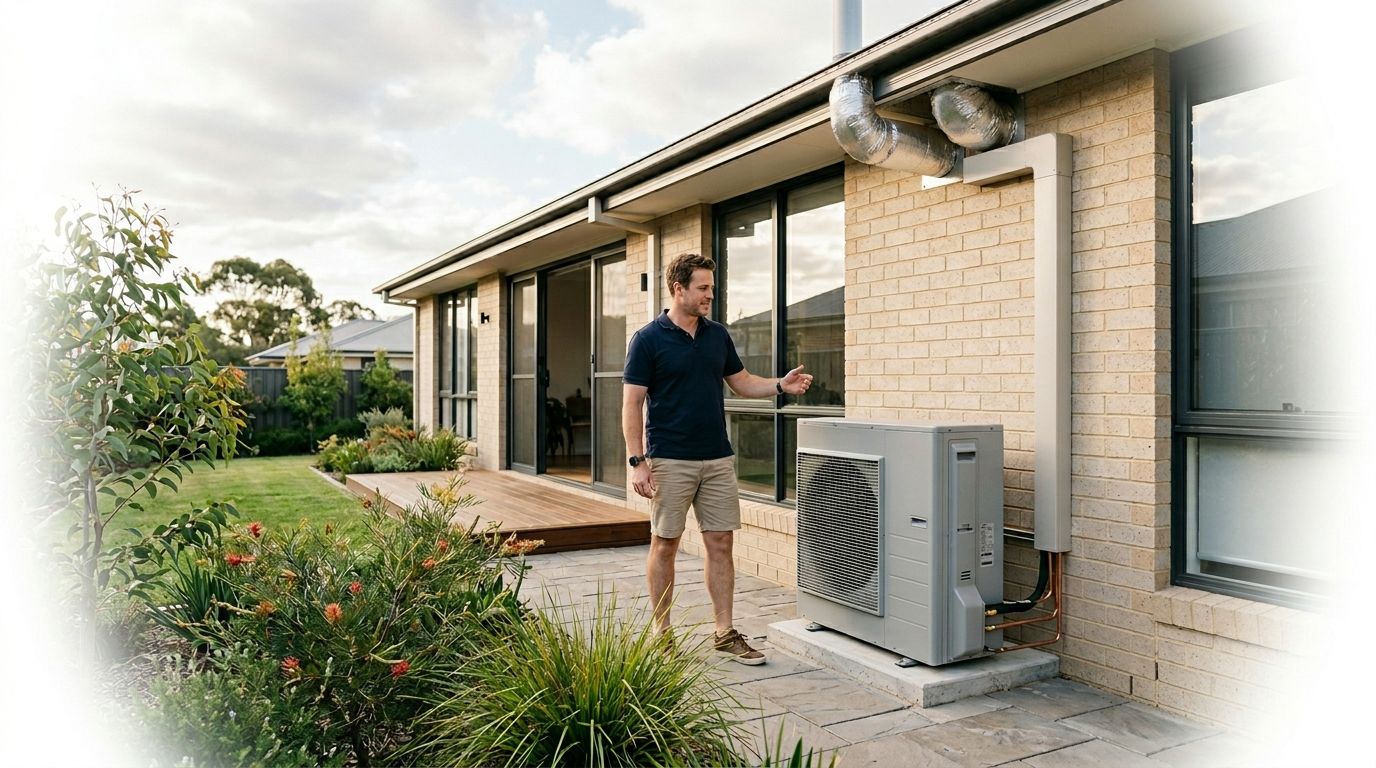
The system works in a continuous loop. The outdoor compressor unit circulates refrigerant to the indoor air handler, which sits in the roof cavity or a ceiling void. That unit draws warm room air across a refrigerant coil, cools or heats it, and then pushes the conditioned air into the duct network. From there, the air travels through the ducts and flows into each room via supply vents, usually mounted in the ceiling.
Return air grilles, typically one or two larger vents in a central hallway or living area, pull stale room air back to the indoor unit to be reconditioned. This closed loop keeps temperatures consistent across the whole home without the need for individual wall units in every room.
Key takeaways
- Air conditioning ductwork carries conditioned air from a central unit to every room via insulated channels.
- Flexible ductwork is the most common choice for Sydney homes due to its cost-effectiveness and adaptability.
- Proper installation and maintenance prevent common issues like kinked ducts and air leaks.
The 4 Types of Air Conditioning Ductwork Used in Australian Homes
Not all ductwork is the same. The material and construction of your ducts affects airflow efficiency, insulation performance, installation cost and how long the system lasts. There are four main duct types used in Australian residential and light commercial installs, each suited to different building types and budgets.
| Duct Type | Material | Best For | Key Advantage | Key Limitation |
|---|---|---|---|---|
| Flexible ductwork | Wire coil core, fibreglass insulation, foil vapour barrier jacket | Sydney residential installs, Federation and brick-veneer homes | Easy to route around ceiling joists and obstacles; cost-effective | Prone to airflow loss if kinked, sagged or poorly supported |
| Sheet metal (rigid) | Galvanised steel | Commercial builds and large residential projects | Extremely durable; maintains shape and airflow over decades | Higher labour cost; harder to retrofit into existing roof cavities |
| Fibreboard (rigid) | Compressed fibreglass duct board | Older residential installs; some light commercial | Good thermal insulation built into the duct wall itself | Less common in modern installs; can deteriorate if moisture enters |
| Fabric/textile ducts | Permeable polyester fabric | Commercial spaces (gyms, warehouses, open-plan offices) | Even air distribution across large open areas; easy to clean | Rarely used in residential; not suited to standard ceiling voids |
For the vast majority of Sydney homes, flexible ductwork is the go-to choice. It suits the mix of Federation weatherboard houses on the Upper North Shore, brick-veneer homes across the Inner West and contemporary builds throughout the North Shore, where roof cavities vary in height and ceiling joists create obstacles that rigid duct simply cannot navigate as easily.
Flexible Ductwork: The Most Common Choice for Sydney Homes
Flexible ductwork consists of a spiral wire coil core that holds the duct open, wrapped in a layer of fibreglass or polyester insulation, and then enclosed in an outer foil vapour barrier jacket. This construction keeps conditioned air at the right temperature as it travels from the indoor unit to each room vent. Australian installs typically use flex duct rated at R1.0 to R1.5, with R1.5 being the preferred spec for homes in Sydney's climate where both summer cooling and winter heating loads are significant.
The wire coil core gives flex duct its flexibility, but that same quality is also its biggest vulnerability. Every bend in the duct reduces airflow. A sharp 90-degree kink can cut airflow to a room by 50% or more, and a sagging section that pools in the middle of a ceiling void creates back-pressure that forces the indoor unit to work harder. Proper installation means supporting flex duct at regular intervals, keeping bends as gradual as possible and avoiding any compression of the insulation jacket.
Poorly installed flexible ductwork is one of the most common causes of uneven room temperatures in Sydney homes. If one bedroom is always warmer than the rest of the house, a kinked or undersized flex duct run is often the first thing a qualified installer will check.
Key Components of a Ducted Air Conditioning System
A complete ducted air conditioning system is made up of six distinct physical components, each with a specific job. Understanding what each part does helps you make sense of an installation quote, ask the right questions before work begins and know what to look for if something goes wrong down the track.
- Outdoor condenser/compressor unit. This is the large box mounted outside your home, usually on a concrete pad at ground level or on a rooftop bracket. It houses the compressor, condenser coil and fan. The compressor circulates refrigerant between the outdoor and indoor units, doing the heavy lifting of the refrigeration cycle.
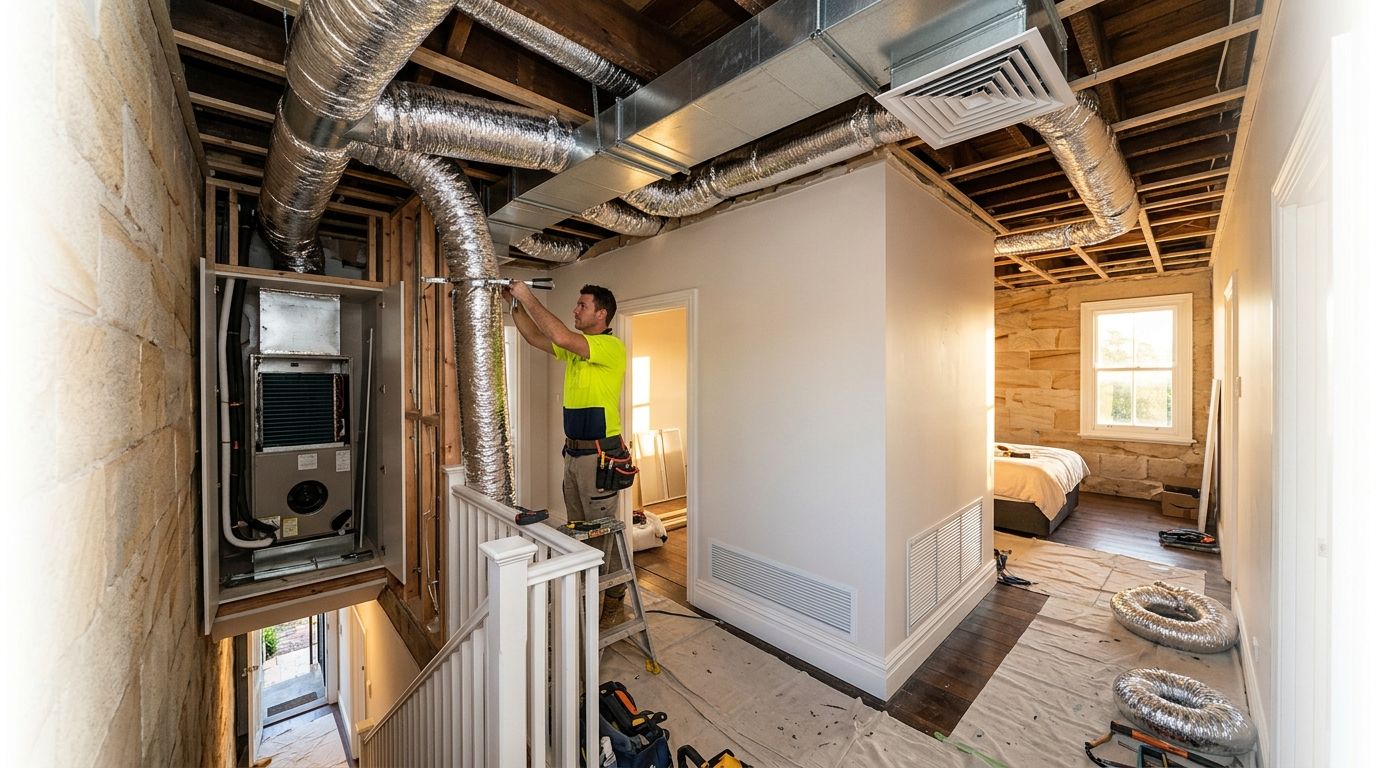
- Indoor air handler (fan coil unit). Typically ceiling-mounted inside the roof cavity, this unit draws warm room air across a refrigerant coil, conditions it and pushes it into the duct network. Daikin's FWA ducted fan coil series and Fujitsu's ARTG series are two of the most common units AirFlow Australia installs across North Shore and Upper North Shore homes.
- Supply air ductwork network. The branching network of insulated ducts that carries conditioned air from the indoor unit to each room. In most Sydney homes this is flexible ductwork routed through the roof cavity.
- Supply air diffusers and grilles. The ceiling vents in each room where conditioned air enters the space. Diffuser design affects how evenly air spreads across the room.
- Return air grilles and return ductwork. Larger vents, usually in a central hallway or living area, that pull stale room air back to the indoor unit to be reconditioned. A well-designed return air path is just as important as the supply side.
- Zone controller or thermostat. The brain of the system. Daikin's ducted systems include an intelligent zone controller with smartphone app integration, making them one of the most popular choices for North Shore homes. Fujitsu's ARTG series pairs with its own smart controller and is well regarded for quiet indoor unit operation, which suits bedroom zones in homes across Wahroonga and Gordon. Third-party controllers like iZone are also compatible with many systems and offer detailed scheduling and energy monitoring through a dedicated app.
Zoning is one of the biggest practical advantages of a ducted system. Rather than conditioning the whole house at once, you divide the home into zones (a typical Sydney home runs four to eight) and only condition the rooms you are actually using. This is one of the most effective ways to run energy efficient air conditioners in a larger home, and it is worth reading up on before you finalise your system design.
How Zoning Controls Work With Your Ductwork
Motorised zone dampers are the physical mechanism that makes zoning possible. Each damper is a circular or rectangular flap that sits inside a duct branch serving a particular zone. The zone controller sends a signal to open or close each damper depending on which zones are active. When you switch off the bedroom zone at night, the damper for that branch closes and the airflow is redirected to the zones that remain on.
There is one practical detail most homeowners do not hear about until after installation. A minimum number of zones must stay open at all times. As a general rule, at least 25% of the system's total duct capacity needs to remain active. If too many dampers close simultaneously, pressure builds up inside the ductwork and forces the indoor unit to work against resistance it was not designed for. This can cause noise, reduce efficiency and shorten the life of the fan motor. A good installer will programme the zone controller to enforce this minimum automatically, so it is worth confirming that setting is in place before handover.
Common Air Conditioning Ductwork Problems and How to Spot Them
Most ductwork problems develop slowly and out of sight, hidden inside the roof cavity where homeowners never look. The five issues below are the ones AirFlow Australia technicians encounter most often in Sydney homes, along with the symptoms you are likely to notice before you ever see the cause.
- Crushed or kinked flexible ductwork. Flex duct is easy to damage. Plumbers, electricians and roof tilers working in the ceiling cavity often push or stand on duct runs without realising the impact. A sharp kink can cut airflow to a room by 50% or more. The symptom is straightforward. One room stays noticeably warmer or cooler than the rest of the house regardless of how long the system runs.
- Air leaks at duct joints and connections. Joints between duct sections, at the plenum box and at diffuser connections are the most common leak points. When conditioned air escapes into the roof cavity instead of reaching the room, you end up paying to cool or heat your ceiling space. The symptom is higher power bills with no obvious explanation, or rooms that take much longer than expected to reach the set temperature.
- Poor insulation and condensation. Ductwork that has lost its insulation jacket, or was installed with undersized insulation, allows the cold duct surface to attract moisture from warm roof cavity air. Over time this leads to condensation on the duct exterior, which can soak into ceiling plasterboard or create conditions for mould growth inside the duct. A musty smell from ceiling vents is the most common sign homeowners notice first.
- Undersized or oversized ductwork. Duct diameter needs to be matched to the airflow volume the system is designed to deliver. Undersized ducts create back-pressure and noise; oversized ducts reduce air velocity so much that conditioned air barely reaches the far end of a long run. Both problems are usually the result of poor design at the time of installation and can add significantly to how much ducted aircon costs in Australia if the ductwork needs to be partially replaced to fix it.
- Dirty or blocked return air grilles. Return air grilles collect dust, pet hair and debris over time. A heavily blocked return grille restricts the volume of air the indoor unit can draw in, reducing system efficiency and putting extra strain on the fan motor. The symptom is reduced airflow from supply vents across the whole house, even though the system appears to be running normally. This is one of the easiest problems to fix. A thorough clean of the grille and filter is often all that is needed.
The frustrating reality is that most of these problems are completely invisible from inside the home. You cannot see a kinked duct or a leaking joint from the living room floor. The most reliable way to catch ductwork issues early is through a professional air conditioning service inspection, where a technician can access the roof cavity, check duct condition, measure airflow at each diffuser and identify any problems before they become expensive repairs.
What to Expect During a Ducted Air Conditioning Installation in Sydney
A standard ducted air conditioning installation in a Sydney home follows a clear sequence of steps, from the first site visit through to final commissioning. Knowing what happens at each stage means you can plan around the work, ask the right questions and hold your installer to account. For a typical four-zone install in a Sydney home, the full process takes one to two days.
- Site inspection and load calculation. Before any equipment is ordered, a qualified installer visits the property to measure each room, assess insulation levels, check ceiling heights and plan the duct routing through the roof cavity. A heat load calculation determines the correct system capacity in kilowatts. Getting this step right is the single biggest factor in whether the finished system performs as expected.
- Outdoor unit placement. The outdoor condenser is positioned on a concrete ground slab, a rooftop bracket or a wall-mounted bracket depending on the available space and the home's layout. Clearance from fences, neighbouring properties and windows is checked against manufacturer requirements at this stage.
- Indoor air handler installation. The fan coil unit is lifted into the roof cavity and secured to the ceiling structure. Mitsubishi Electric's PEAD series ducted units are a popular choice for larger Sydney homes, and their slim-profile design makes them particularly well suited to the shallow roof cavities common in terrace homes in Balmain and Leichhardt where ceiling void depth is limited.
- Ductwork fabrication and installation. Flexible duct runs are measured, cut and routed from the indoor unit's plenum box through the ceiling space to each zone. Homes in suburbs like Wahroonga, Gordon and Pymble typically have generous roof cavities that make routing straightforward. Terrace homes in Balmain or Newtown often require more creative solutions, such as routing ducts through internal wall cavities or using smaller-diameter branches to navigate tight spaces.
- Supply diffusers and return air grilles. Ceiling openings are cut at each supply point and return air location. Diffusers are fitted flush to the ceiling plasterboard and connected to the duct branches. Return air grilles are installed in central locations, usually a hallway or open living area, to ensure even air draw across the home.
- Zone controller and wiring. The zone controller is mounted on a wall in a convenient location, typically near the main living area. Wiring runs back to the indoor unit and to each motorised zone damper. At this stage the installer programmes the minimum open-zone settings to protect the indoor unit from excessive back-pressure.
- Refrigerant line-set connection and pressure testing. Copper refrigerant lines connecting the outdoor and indoor units are insulated, run through the wall and connected at both ends. The system is then pressure-tested with nitrogen to confirm there are no leaks before refrigerant is introduced. All AirFlow Australia installations are carried out by Arctick-registered refrigerant handlers, as required under Australian law.
- System commissioning and airflow balancing. The system is powered up and run through a full operational check. Airflow at each diffuser is measured and balanced so every room receives the correct volume of conditioned air. The installer walks you through the zone controller operation and confirms the system is performing to specification before leaving the site.
Every AirFlow Australia ducted installation comes with a five-year installation warranty. If anything related to the workmanship develops a fault within that period, we return to fix it at no charge.
Frequently Asked Questions About Air Conditioning Ductwork
Can I install air conditioning ductwork myself?
No. Installing ducted air conditioning ductwork in Australia requires an Arctick licence to handle refrigerants and a licensed electrician for the electrical connections. Even the mechanical ductwork itself needs to be designed and installed to meet Australian Standard AS/NZS 3000 and local building codes. Attempting a DIY install risks voiding the manufacturer warranty, failing a building inspection and creating safety hazards.
Is ducted air conditioning bad for your health?
A properly maintained ducted system is not bad for your health. The risk arises when filters and ductwork are left uncleaned for extended periods, allowing dust, mould spores and allergens to accumulate and then circulate through the home. Annual filter cleaning and a professional air conditioning service every two to three years keeps the system hygienic and the air quality in your home well within acceptable levels.
What type of ductwork is best for air conditioning?
For most Australian residential homes, flexible ductwork insulated to R1.5 is the best practical choice. It is cost-effective, easy to route around ceiling joists and obstacles and performs well across Sydney's climate range. Sheet metal rigid ductwork offers greater durability and is preferred for commercial builds or large residential projects where long straight duct runs make fabrication practical.
What is the difference between a duct and a plenum?
A duct is the individual insulated channel that carries conditioned air from one point to another. A plenum is the larger central chamber that connects directly to the indoor air handler and acts as a distribution hub, with individual duct branches running off it to each room or zone. Think of the plenum as the trunk of a tree and the ducts as the branches.
Ready to Upgrade Your Home's Ductwork? Talk to AirFlow Australia
Air conditioning ductwork is the backbone of any ducted system. The type of duct installed, how well it is designed and how carefully it is maintained directly determines the comfort, energy efficiency and air quality your system delivers. Professional installation and regular servicing are not optional extras. They are what separates a system that performs for 15 years from one that causes headaches within the first two.
If your home has an ageing ducted system, rooms that never quite reach the right temperature, or you are planning a new install from scratch, the best first step is a proper site inspection. AirFlow Australia's team works across Sydney's Inner West, North Shore and Upper North Shore, and we bring genuine local knowledge to every job, from shallow roof cavities in Balmain terraces to generous ceiling voids in Wahroonga Federation homes.
Call us on 0423 535 905 to book a site inspection and free quote. We will assess your roof cavity, calculate the right system capacity for your home and give you a clear, honest recommendation before any work begins.