

Why Your Air Conditioner Is Leaking Water
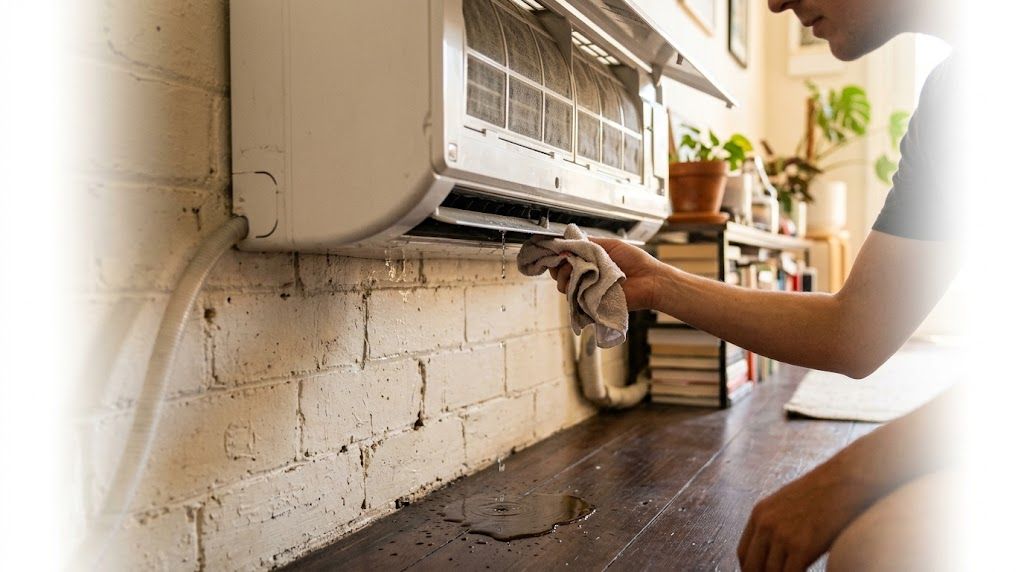
It's a humid January afternoon in a Newtown terrace and you notice a steady drip coming from your indoor unit, pooling on the floorboards below. An air conditioning water leak is one of the most common complaints Sydney homeowners raise, and the good news is that most causes are straightforward to diagnose and fix. Condensation is a normal by-product of the cooling process, but when that water ends up on your floor instead of draining away quietly, something has gone wrong. This article covers the five most common causes, what each one looks like in practice, and what you should do about it.
Key takeaways
- Air conditioning water leaks usually stem from blocked drain lines, dirty filters, damaged drain pans, low refrigerant or failed pumps.
- Most causes can be prevented with regular filter cleaning and annual professional maintenance.
- Some repairs are DIY fixes, while refrigerant work and pump replacement require a licensed technician.
5 Common Causes of an Air Conditioning Water Leak
Most indoor unit leaks trace back to one of five problems: a blocked drain line, dirty filters, a damaged drain pan, low refrigerant causing ice build-up, or a failed condensate pump. Understanding which one you are dealing with helps you decide whether it is a quick DIY fix or a job for a licensed technician.
Blocked Condensate Drain Line
The condensate drain line carries moisture collected by the evaporator coil out of your home, usually to an external drain or overflow point. Over time, dust, mould and algae accumulate inside the line and form a blockage. When that happens, water has nowhere to go and backs up into the drain pan until it overflows into the room. A blocked drain line is the single most common cause of an indoor unit drip. In Sydney's humid summer months the volume of condensate produced can be surprisingly high, meaning a partial blockage can become a full overflow within hours.
Dirty or Clogged Air Filters
Dirty filters restrict the airflow passing over the evaporator coil. With less warm air moving across it, the coil temperature drops below the dew point and the coil begins to ice over rather than simply collecting condensate in a controlled way. When the unit cycles off, that ice melts rapidly and the drain pan is overwhelmed by the sudden volume of water. Sydney's dusty summer conditions mean filters can clog faster than most people expect. Cleaning your filters every four to six weeks during the cooling season is the simplest preventive step you can take.
Damaged or Overflowing Drain Pan
The drain pan sits directly beneath the evaporator coil and catches all the condensate before it flows into the drain line. Cracks, rust or misalignment allow water to escape before it ever reaches the drain. Older units are particularly vulnerable. In Federation-era homes in suburbs like Wahroonga or Balmain, drain pans in systems that have been running for 10 or more years may have corroded through entirely. Misalignment is also common after a DIY filter clean where the panel is not refitted correctly. A cracked or corroded pan is a straightforward repair, but accessing it safely requires a technician.
Low Refrigerant and Ice Build-Up
Low refrigerant reduces the pressure inside the system, which causes the evaporator coil to run far colder than it should. The coil freezes over completely, and when the unit shuts down the ice melts all at once, producing far more water than the drain pan can handle. You may notice ice visible on the indoor unit or refrigerant lines before the leak becomes obvious. Refrigerant work is regulated under Australian law and must be carried out by an Arctick-licensed technician. This is not a DIY fix under any circumstances. Book professional air conditioning repairs with AirFlow Australia if you suspect a refrigerant issue.
Faulty Condensate Pump
Not every installation can rely on gravity to move condensate to a drain point. Ceiling cassette systems and ducted units in multi-storey homes often use a condensate pump to lift water up and away to the nearest drain. If that pump fails, water simply accumulates in the tray until it overflows. This is a particularly common issue in North Shore apartments and townhouses where the indoor unit sits well above the nearest drainage point. Fujitsu ASTG Series ceiling cassette units are popular in these installations and, like any cassette system, depend entirely on a functioning pump to stay dry. A failed pump is usually a straightforward replacement, but it does require a technician to access the unit safely.
Which Fixes Can You Do Yourself (and Which Need a Pro)?
Some air conditioning water leak fixes are genuinely straightforward and safe for any homeowner to tackle, while others involve refrigerant, electrical components or confined access that must be handled by a licensed technician. The table below breaks down the five most common causes by who should fix them, how long it takes and what it typically costs in Sydney.
| Cause | DIY or Pro? | Estimated Fix Time | Typical Cost (AUD) |
|---|---|---|---|
| Dirty or clogged air filters | DIY | 10 minutes | $0 |
| Blocked condensate drain line | DIY (minor blockage) | 20 minutes | $0 to $15 (wet-dry vac hire) |
| Damaged or cracked drain pan | Pro | 1 to 2 hours | $150 to $300 |
| Low refrigerant and ice build-up | Pro only | 1 to 2 hours | $200 to $450 |
| Faulty condensate pump | Pro | 1 to 2 hours | $180 to $350 |
For a broader breakdown of what to expect, see our guide on how much it costs to service an air conditioner in Australia.
A word of caution on the 'Pro only' jobs. Attempting refrigerant work without an Arctick licence is a breach of Australian regulations under the Ozone Protection and Synthetic Greenhouse Gas Management Act and carries significant fines. Beyond the legal risk, any DIY work on refrigerant or electrical components will void your manufacturer warranty immediately. If you are dealing with a refrigerant leak or a pump failure and need it sorted quickly, AirFlow Australia offers same-day repair availability across Sydney so you are not left with a dripping unit and a bucket on the floor overnight.
How to Prevent an Air Conditioning Water Leak
The majority of air conditioning water leaks are entirely preventable with a consistent maintenance routine. Blocked drain lines, iced-up coils and overflowing drain pans rarely appear without warning. They build up gradually over weeks or months of neglect, which means a small amount of regular attention is all it takes to avoid an expensive repair call.
Sydney's humid summers make proactive maintenance especially worthwhile. High ambient humidity means your system is producing more condensate than it would in a drier climate, so any partial blockage or drainage issue escalates faster. Follow these four steps to keep your system dry and running efficiently:
- Clean or replace filters every four to six weeks during heavy use. Dirty filters are the leading cause of coil icing and the easiest problem to prevent. A quick rinse under the tap takes 10 minutes and costs nothing.
- Book an annual professional service to flush the drain line and inspect the drain pan. A technician will clear any early-stage blockages and spot cracks or corrosion in the pan before they become a leak.
- Schedule a deep clean every one to two years to remove mould and debris from the coil and drain tray.AirFlow Australia's air conditioner cleaning service removes the mould and debris that cause drain blockages, restoring airflow and drainage to factory condition.
- Check that the outdoor unit is sitting level. A tilted outdoor unit can cause condensate to pool incorrectly inside the system rather than draining away. This is easy to check visually and a simple fix if caught early.
Two of the most popular split systems we install in Sydney, the Daikin Cora Series and the Mitsubishi Electric MSZ-AP Series, both carry five-year manufacturer warranties. Keeping those warranties valid requires annual professional servicing, and both units benefit noticeably from regular filter cleaning and drain tray maintenance given how hard they work through a Sydney summer. Skipping a service is rarely worth the risk to your warranty coverage.
For a full seasonal routine, see our air conditioner maintenance checklist.
When to Call a Sydney Air Conditioning Technician
Some leaks are a quick DIY fix, but certain warning signs mean you should stop troubleshooting and call a licensed technician straight away. Water pooling on the floor rather than a slow drip, visible ice on the indoor unit or refrigerant lines, a musty smell suggesting mould has taken hold in the drain tray, or a leak that returns within a few days of a DIY flush are all signals that the problem is beyond a filter clean and a wet-dry vac.
AirFlow Australia is fully licensed, Arctick registered and carries a five-year installation warranty on all work. Same-day repairs are available across Sydney's Inner West and North Shore, so you are not left managing a bucket on the floor while you wait for a booking. Book an air conditioning service with AirFlow Australia and we'll diagnose the leak and have your system running cleanly again. Call us on 0423 535 905 or request a free quote online.
Frequently Asked Questions
Why is my air conditioner leaking water inside the house?
An air conditioner leaks water inside the house when condensate cannot drain away properly. The most common causes are a blocked drain line, dirty filters causing the evaporator coil to ice over, a cracked or misaligned drain pan, or a failed condensate pump. Cleaning your filters and flushing the drain line resolves most cases, but persistent or heavy leaks need a licensed technician to inspect the system.
Is it normal for an air conditioner to drip water?
A small amount of condensation on the outdoor unit is completely normal, as is a slow drip from the external drain outlet during heavy cooling. Water dripping from the indoor unit onto your floor or ceiling is not normal and indicates a drainage problem that needs attention. Left untreated, even a minor indoor drip can cause water damage to walls, ceilings and flooring.
Can I run my air conditioner if it is leaking water?
Running a leaking air conditioner for a short time while you arrange a repair is generally safe, but it is not advisable to leave it running unattended. If you can see ice on the indoor unit, turn the system off immediately and let it defrost before calling a technician. Continuing to run a unit with a refrigerant issue or a failed pump risks further damage to the system and water damage to your home.
How much does it cost to fix an air conditioner water leak in Sydney?
The cost to fix an air conditioning water leak in Sydney depends on the cause. Clearing a blocked drain line typically costs $80 to $150 as part of a service call, while replacing a cracked drain pan runs $150 to $300. Refrigerant-related repairs, including recharging and leak sealing, generally cost $200 to $450. A failed condensate pump replacement sits in the $180 to $350 range. Annual servicing is the most cost-effective way to avoid these repairs altogether.