
What Does a Daikin Aircon Blinking Green Light Actually Mean?
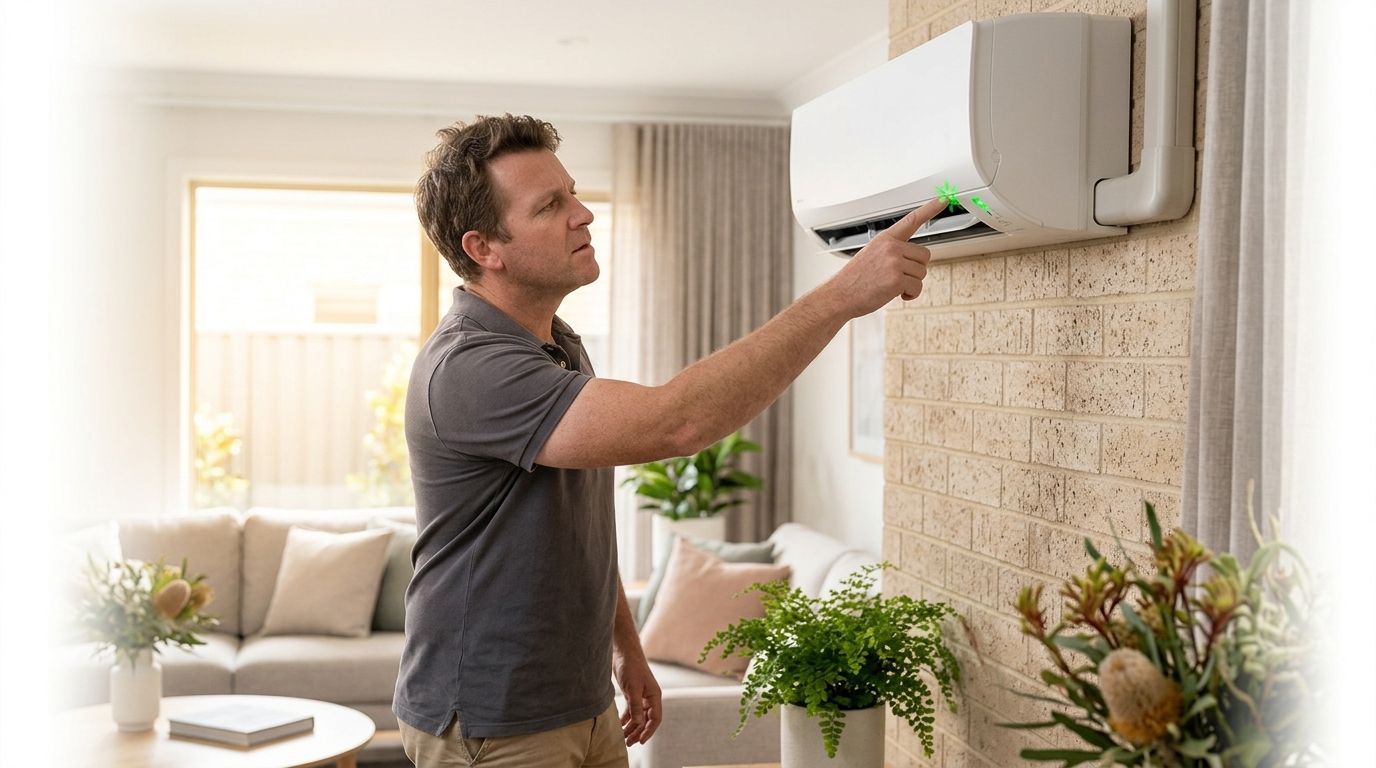
If you've spotted your Daikin aircon blinking green light on a sweltering Sydney evening, you're not alone. A homeowner in Wahroonga or Newtown might walk past their split system and notice the operation light flashing rhythmically instead of glowing steady. That's the unit's built-in self-diagnostic system trying to tell you something. A steady green light means the system is running normally. A flashing pattern means a fault or status condition has been detected and needs your attention.
Daikin encodes fault information directly into the flash sequence. The number of times the light blinks before pausing maps to a specific fault category, so counting those flashes is your first step toward a diagnosis.
Key takeaways
- A Daikin aircon blinking green light indicates a fault detected by the unit's self-diagnostic system.
- Flash count patterns correspond to specific error codes and fault categories.
- Many faults can be safely checked yourself before calling a technician.
This article covers what the different flash patterns and fault codes mean, which checks you can safely do yourself and which faults require a licensed technician to fix.
Common Reasons Your Daikin Green Light Is Flashing
A flashing green operation light on a Daikin split system is the unit's way of logging a fault without a display screen. The indoor unit flashes a set number of times, pauses for a couple of seconds, then repeats the sequence. Counting those flashes accurately is the single most useful thing you can do before calling a technician, because each number points to a different fault category. Here are the four causes we see most often across Sydney homes.
Dirty or Blocked Air Filters
Clogged air filters are the most common trigger for a blinking operation light on Daikin split systems, and the good news is that it's the easiest fault to fix yourself. When filters are heavily loaded with dust and debris, airflow through the indoor unit drops sharply. The unit's temperature sensors detect abnormal heat build-up across the evaporator coil and trip a fault to protect the system from damage.
Daikin recommends cleaning filters every two weeks during heavy-use periods, such as Sydney's January and February heat. In practice, many homeowners stretch this to once a month, which is often enough to avoid a fault, but during a heatwave that schedule can catch you out.
This is particularly common on the Daikin Cora series (for example, the FTXM25Y 2.5kW) and the Daikin Alira X series (for example, the FTXM35Y 3.5kW), both of which are popular installs across Sydney's Inner West and Upper North Shore. Their high-efficiency coils are sensitive to restricted airflow, so filter maintenance matters more than it does on older, less efficient models.
For a step-by-step walkthrough, see our guide on how to clean air conditioner filters. After cleaning, reset the filter sign on your remote and run the unit for 10 minutes to confirm the fault clears.
Refrigerant Leak or Low Refrigerant Pressure
A refrigerant issue is one of the more serious causes of a blinking green light. On older Daikin inverter models, this typically shows as five or six flashes in the operation light sequence. Newer units running R32 refrigerant, including current Cora and Alira X models, will often display an alphanumeric code such as A3 or E3 on the remote's LCD screen alongside the flashing light.
Low refrigerant pressure means the system cannot transfer heat properly, so cooling performance drops and the unit faults out to prevent compressor damage. Refrigerant handling is licensed work under Australian law. Technicians must hold an Arctick registration to purchase, handle or recharge refrigerant, so this is not a DIY fix under any circumstances. If you suspect a refrigerant leak, switch the unit off and contact AirFlow Australia's repair team to book a diagnosis.
Communication Error Between Indoor and Outdoor Units
A communication fault between the indoor head unit and the outdoor compressor is another common cause of a blinking green light, and it tends to appear after storms or power surges, both of which Sydney sees regularly through summer. The two units talk to each other via a signal wire in the interconnecting cable. If that connection is disrupted by a loose terminal, a surge-damaged control board or a failing PCB, the indoor unit loses contact with the outdoor unit and logs a fault.
Symptoms often include the unit attempting to start, then shutting down within a minute or two. If you've had a recent power outage or a storm in your area, a communication error is a strong candidate. A licensed technician will check wiring continuity and test both control boards to isolate the fault.
Outdoor Unit Fault or Compressor Overload
On a 38°C Sydney summer day, the outdoor condenser unit works extremely hard to reject heat. If the unit is installed in a poorly ventilated spot, such as a narrow side passage with no airflow or in direct western afternoon sun without any shade, the condenser can overheat and trigger a high-pressure fault. The indoor unit then blinks to signal that the outdoor unit has shut down for protection.
As a quick check, confirm that your outdoor unit has at least 30 cm of clear space on all sides and that the condenser fins are not blocked by leaves, garden debris or a fence that's been built too close. If clearance looks fine but the unit still faults on hot days, the compressor itself may be drawing excessive current, which requires a technician to test with a clamp meter. Do not keep restarting the unit repeatedly, as this can cause further compressor damage.
Daikin Flash Code Reference: What Each Blink Pattern Means
On most Daikin split systems, the green operation light flashes a set number of times, pauses, then repeats. That number maps directly to a fault category. The table below covers the six most common flash counts you'll see on Daikin indoor units installed across Sydney homes, along with the fault code, the likely cause and whether it's a safe DIY check or a job for a licensed technician.
| Flash Count | Fault Code | Likely Cause | DIY or Pro Fix |
|---|---|---|---|
| 1 flash | C4 / Indoor fan motor fault | Indoor fan motor has failed or is drawing abnormal current. Often caused by a seized bearing or failed capacitor. | Pro fix. Do not attempt to run the unit. Book a technician to test and replace the fan motor. |
| 2 flashes | E5 / Indoor PCB fault | The indoor unit's printed circuit board has detected an error. Can follow a power surge or lightning strike. | Pro fix. PCB diagnosis and replacement requires a licensed technician. |
| 3 flashes | E7 / Outdoor fan motor fault | Outdoor fan motor is not running or is running outside normal parameters. Check for debris blocking the fan blade first. | DIY: visually check for obstructions. If clear, book a technician to test the motor and capacitor. |
| 4 flashes | L4 / Compressor overload or high discharge temperature | Compressor is overheating, often due to poor outdoor unit ventilation, a dirty condenser coil or a failing compressor. | DIY: check outdoor unit clearance and clean condenser fins. If fault persists, call a technician. |
| 5 flashes | A3 / E3 / Refrigerant or pressure fault | Low refrigerant pressure or a refrigerant leak. The system cannot transfer heat and has shut down to protect the compressor. | Pro fix only. Refrigerant handling requires Arctick registration under Australian law. |
| 9 flashes | U4 / Communication error | The indoor and outdoor units have lost communication. Common after power surges, storms or a loose interconnecting cable terminal. | DIY: try a soft reset (power off at the wall for 30 seconds). If fault returns, book a technician. |
One important note on newer Daikin inverter models: the flash-count system is only part of the picture. Units in the Daikin Cora series, the Daikin Alira X series (such as the FTXM35Y 3.5kW) and the premium Daikin Zena series (such as the FTXJ25T 2.5kW) will typically display an alphanumeric error code directly on the remote's LCD screen, for example U4, E7 or A3, alongside or instead of the flashing operation light. That remote display is always the most reliable diagnostic source, so check it first before counting flashes. For help decoding what the icons on your remote mean, see our Daikin air conditioner symbols explained guide.
What to Try Before Calling a Technician
Before booking a repair call, there are five checks any Sydney homeowner can safely carry out on a blinking Daikin unit. None of these steps involve opening the unit, touching refrigerant or working on electrical wiring. They take less than 10 minutes and, in many cases, will clear the fault entirely.
- Power off the unit at the wall and wait 30 seconds before restarting. Switch the unit off at the isolator switch or wall socket, not just on the remote. Wait a full 30 seconds to allow the control board to discharge and reset. Then power it back on and observe whether the fault clears. This soft reset resolves a surprising number of communication errors and minor sensor faults. For a full walkthrough of the reset procedure, see our guide on how to reset a Daikin air conditioner.
- Check and clean the indoor air filters. Open the front panel of the indoor unit and remove the mesh filters. Hold them up to the light. If you can't see through them clearly, they need a clean. Rinse under lukewarm water, let them dry fully and reinstall. Blocked filters are the single most common cause of a blinking operation light on Daikin split systems, particularly on high-efficiency models like the Cora and Alira X series.
- Check that the outdoor unit is unobstructed. Walk outside and confirm the outdoor condenser has at least 30 cm of clear space on all sides. Remove any leaves, garden debris or objects that have accumulated around the unit. Check that the condenser fins on the sides of the unit are not visibly bent or clogged with dirt.
- Check the circuit breaker has not tripped. Head to your switchboard and confirm the breaker for the air conditioning circuit is in the 'on' position. A tripped breaker will prevent the outdoor unit from receiving power, which can cause the indoor unit to flash a communication or outdoor unit fault code even though the underlying issue is simply a tripped switch.
- Note the exact flash count or remote error code before calling a technician. Count the number of flashes carefully and write it down, or take a short video on your phone. If your remote's LCD is showing an alphanumeric code such as U4 or A3, photograph it. Giving a technician this information upfront cuts diagnosis time significantly and means they can arrive with the right parts for the most likely fault.
If the fault clears after any of these steps, run the unit for 15 to 20 minutes and monitor it. If the blinking returns, the underlying fault is still present and a licensed technician will need to investigate further.
When a Blinking Green Light Means You Need a Licensed Technician
Some Daikin fault codes are safe to investigate yourself, but four specific scenarios require a licensed technician and must not be treated as DIY jobs. Refrigerant leaks, PCB or control board failures, compressor faults and any fault that returns immediately after a reset all fall into this category. Attempting any of these yourself risks further damage to the unit and, in the case of refrigerant work, carries serious legal consequences under Australian law.
Refrigerant handling is regulated under the Ozone Protection and Synthetic Greenhouse Gas Management Act. Any technician who purchases, handles or recharges refrigerant must hold a current Arctick licence. Homeowners who attempt to top up or vent refrigerant themselves face fines of up to $12,600 per offence. If your Daikin is showing a five-flash pattern or an A3 or E3 code on the remote, switch the unit off and leave it alone until a licensed technician arrives.
PCB and control board replacements are equally off-limits for DIY. These boards manage every function in the unit, from inverter frequency to fan speed control, and incorrect handling can destroy a board that might otherwise have been repairable. Compressor faults are the most expensive outcome of all. A compressor replacement on a Daikin split system typically runs $800 to $1,500 in parts alone, which is why catching a fault early matters so much. A professional diagnostic visit in Sydney generally costs $80 to $150 before parts, and that early investment can prevent a compressor fault from escalating into a full unit replacement.
AirFlow Australia's air conditioning repairs team is available for same-day and emergency bookings across Sydney's North Shore and Inner West, including suburbs like Wahroonga, Chatswood, Newtown and Balmain. If your Daikin is blinking and the fault returns after a reset, call us on 02 8000 0604 to get a technician out quickly before the problem gets worse.
Frequently Asked Questions
Why is my Daikin aircon blinking green but not cooling?
A blinking green operation light that appears alongside a loss of cooling usually points to a refrigerant pressure fault, a compressor overload or a communication error between the indoor and outdoor units. Count the number of flashes before the pause and cross-reference with the fault code table above. If the unit is blinking five times and the remote shows an A3 or E3 code, the system has shut down to protect the compressor from running without adequate refrigerant pressure. Switch the unit off and book a licensed technician rather than attempting to restart it repeatedly.
How do I reset a Daikin aircon blinking green light?
Turn the unit off at the wall isolator or power socket, not just on the remote, and leave it off for a full 30 seconds. This allows the control board to fully discharge and clear any temporary fault flags. Power the unit back on and observe whether the green light returns to a steady glow. If the blinking resumes within a few minutes of restarting, the underlying fault is still active and a soft reset alone will not fix it.
Is a blinking green light on a Daikin serious?
It depends entirely on the flash count. A single flash indicating a fan motor fault or five flashes indicating a refrigerant issue are both serious faults that require a licensed technician. A blinking light caused by dirty filters or a minor communication glitch that clears after a reset is far less serious. The key is to identify the exact flash pattern or remote error code before deciding how urgently to act. Any fault that returns after a reset should be treated as serious regardless of the flash count.
Can I fix a Daikin green light blinking fault myself?
You can safely carry out a handful of checks yourself: cleaning the air filters, clearing debris from around the outdoor unit, checking the circuit breaker and performing a soft reset at the wall. These steps resolve a meaningful number of faults, particularly on popular models like the Daikin Cora series and the Daikin Alira X series where filter-related faults are common. Anything beyond those checks, including refrigerant work, PCB replacement or compressor testing, must be handled by a licensed technician. Attempting refrigerant work without an Arctick licence is illegal in Australia and can result in significant fines.
Stop the Blink: Get Your Daikin Running Again
A blinking green light on your Daikin split system is the unit's built-in way of flagging that something needs attention. Most faults fall into a handful of categories: dirty filters, refrigerant pressure issues, communication errors between the indoor and outdoor units, and compressor or outdoor unit overloads. Filter cleans and soft resets are safe to try yourself. Refrigerant faults, PCB failures and compressor problems need a licensed technician every time.
If you've worked through the checks in this article and the blinking keeps coming back, don't keep restarting the unit and hoping for the best. Each restart on a faulting compressor adds wear and can turn a $150 repair into a $1,500 one.
AirFlow Australia's repair team covers Sydney's North Shore, Inner West and surrounding suburbs, including Wahroonga, Chatswood, Newtown and Balmain. Call us on 0423 535 905 or book an air conditioning service online and we'll get your Daikin running properly again.