
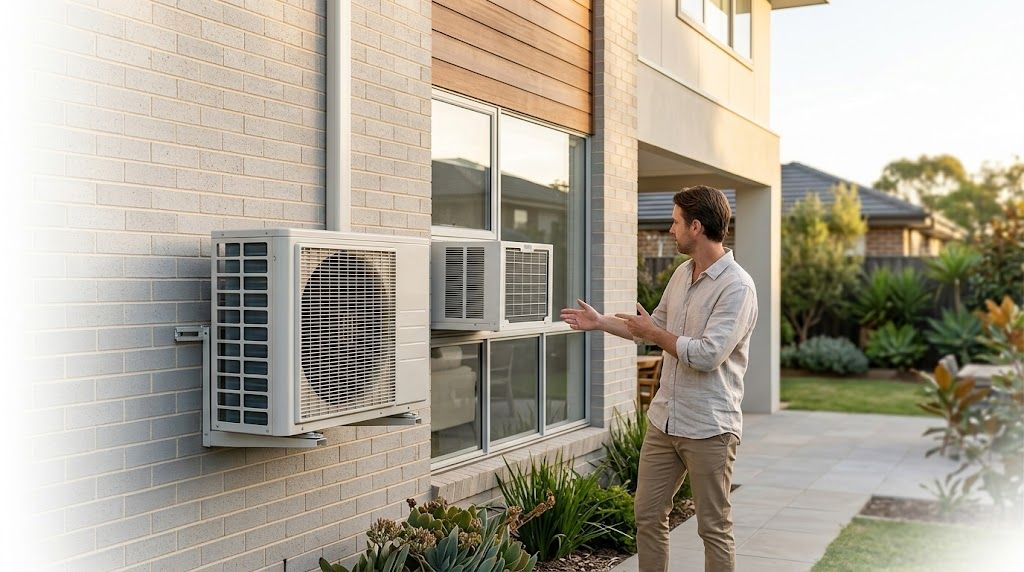
Split System vs Air Conditioning Window Unit: The Core Difference
A split system and an air conditioning window unit are the two most common choices for cooling a single room in a Sydney home. A split system uses two separate components: a wall-mounted indoor unit and an outdoor compressor connected by refrigerant lines. A window unit is a self-contained box that sits in a window frame or wall sleeve, housing everything in one casing. The right choice depends on your budget, your home's layout and how long you plan to stay comfortable.
On a 38-degree January afternoon in a North Shore terrace, both options will cool the room. But they differ significantly across five areas this article covers: upfront cost, installation requirements, running efficiency, noise levels and how well each suits the older homes and apartment buildings common across Sydney's Inner West and North Shore.
Understanding those differences before you buy will save you money and frustration down the track.
Key takeaways
- A split system costs more upfront but uses less energy than a window air conditioner over time.
- Window units suit renters and tight budgets; split systems suit homeowners needing heating and cooling.
- Strata approval is essential in Sydney apartments before purchasing either option.
Cost Comparison: Upfront Price vs Long-Term Running Costs
A split system costs more to buy and install than a window unit, but the total cost of ownership over three to five Sydney summers often tells a different story. The table below compares both options across the figures that actually matter for a household budget.
| Factor | Window Unit | Split System |
|---|---|---|
| Upfront Unit Cost | $300 to $1,000 | $600 to $1,500 |
| Installation Cost | $0 to $200 (DIY or handyperson in most cases) | $600 to $1,500 (licensed electrician and refrigerant handler required) |
| Total Installed Cost | $300 to $1,200 | $1,200 to $3,000 |
| Estimated Annual Running Cost (2.5kW, Sydney summer) | $280 to $420 | $160 to $260 |
| Energy Star Rating Range | 1 to 3 stars (cooling) | 3 to 6 stars (cooling) |
| Typical Lifespan | 5 to 8 years | 10 to 15 years |
For a full breakdown of what professional installation involves and what affects the final price, see our full breakdown of aircon and installation costs in Australia.
Why Running Costs Matter More Than the Sticker Price
Most window units use fixed-speed compressors. The compressor runs at full power until the room hits the target temperature, then switches off completely before blasting back on again. This stop-start cycle draws a surge of power each time it restarts and keeps the room temperature swinging a degree or two either side of comfortable.
Split systems use inverter technology, which works differently. The compressor ramps up quickly to cool the room, then slows to a low, steady speed to hold the temperature. It rarely switches off entirely. Because it is not constantly restarting at full load, it draws significantly less power over the course of a day.
Here is a practical example. A 2.5kW inverter split system running eight hours a day at a Sydney electricity rate of around $0.30 per kWh costs roughly $180 to $220 over a three-month summer. A comparable window unit at a lower star rating running the same hours can cost $280 to $420 for the same period. That gap of $100 to $200 per summer adds up to $500 to $1,000 over five years, which goes a long way toward offsetting the higher installation cost of a split system.

Installation, Strata Rules and Sydney Home Suitability
A window unit can be installed by a competent DIYer in an afternoon, while professional split system installation requires a licensed, Arctick-registered technician to handle refrigerants under Australian law (AS/NZS 3000). That difference in installation complexity is one of the most practical factors separating the two options, and it has real consequences for Sydney homeowners in apartments, strata buildings and heritage-listed streets.
Window units need a suitable opening: a double-hung window of the right dimensions, or a purpose-cut wall sleeve. The trade-off is that the unit permanently occupies that opening, blocking natural light and any view beyond it. For a north-facing bedroom in a Newtown terrace, that is a meaningful sacrifice. Split systems mount high on an interior wall and route refrigerant lines through a small core hole to the outdoor compressor, leaving windows completely clear.
AirFlow Australia handles all compliance paperwork as part of every installation, including Arctick documentation and electrical certificates of compliance. You do not need to chase those yourself.
Apartments, Strata and Heritage Homes: What to Check First
Sydney apartment owners and terrace home buyers face an extra layer of complexity that most product comparison articles skip over entirely. Strata by-laws in many buildings across the Inner West and North Shore explicitly prohibit window units because they alter the building facade, and some by-laws also restrict where an outdoor compressor can be placed or require written approval before any installation proceeds.
Heritage overlays add another consideration. Inner West suburbs including Annandale, Glebe and Leichhardt contain streets with heritage conservation area status, where council guidelines may limit visible external fixtures. A compressor bolted to a front parapet or a window unit protruding from a street-facing facade can trigger a council objection, even if your strata approves it.
The practical advice here is straightforward. Before purchasing either unit type, get written approval from your strata manager. If you own a Federation or Victorian terrace, check your property's heritage overlay status through the NSW Planning Portal. Then book a licensed installer for a site inspection before you spend a dollar on equipment. A good installer will identify any compliance issues during the inspection and advise on the best placement to satisfy both strata and council requirements.
Performance, Noise and Comfort: How the Two Systems Compare
Split systems outperform window units across every measurable comfort metric: cooling efficiency, heating capability, noise levels and air filtration quality. For most Sydney households running a unit through summer and into the cooler months, those differences add up to a noticeably more comfortable home.
The table below puts the key performance figures side by side.
| Performance Factor | Window Unit | Split System |
|---|---|---|
| Heating Capability | Cooling-only in most models | Reverse-cycle heating standard on almost all models |
| Indoor Noise Level | 50 to 65 dB (compressor inside the room) | 19 to 35 dB (compressor kept outside) |
| Air Filtration | Basic single-stage filter | Multi-stage filtration; premium models include PM2.5 and allergen filters |
| Temperature Consistency | Stop-start cycling, 2 to 3°C swings common | Inverter-controlled, holds within 0.5°C of set temperature |
On noise alone, the gap is significant. A window unit running at 55 to 65 dB sits in the same range as a normal conversation or a running shower. A split system indoor unit at 19 to 25 dB is closer to a quiet library. For bedrooms, that difference matters enormously.
For air quality, the Daikin Cora 2.5kW (FTXM25Y), priced at approximately $900 to $1,100 supply, runs at around 19 dB indoors and includes a multi-stage filter that captures dust and larger airborne particles. The Fujitsu ASTG09KMCA 2.5kW, available at approximately $850 to $1,050 supply, is another strong entry-level option AirFlow Australia installs regularly, offering reliable inverter performance at a competitive price point. For households with allergy sufferers, the Mitsubishi Electric MSZ-AP25VGD 2.5kW, priced at approximately $1,050 to $1,250 supply, steps up to advanced allergen filtration that captures finer particles including PM2.5, making it a worthwhile investment for anyone sensitive to dust mites or pollen.
Reverse-Cycle Heating: A Crucial Advantage for Sydney Winters
Sydney winters are mild by national standards, but they are cold enough to matter. Overnight temperatures in Upper North Shore suburbs like Wahroonga and Gordon regularly drop to 5 to 10°C between June and August, and even Inner West homes can feel genuinely cold on a July morning before the sun comes up.
A reverse-cycle split system handles both seasons with a single unit. In summer it cools; in winter it extracts heat from the outside air and pumps it indoors, operating efficiently even at low outdoor temperatures. Most window units are cooling-only, which means a window unit owner needs a separate heater for winter. That second appliance costs money to buy, takes up floor space and draws additional power.
Over a 10-year lifespan, a split system that replaces both a cooling unit and a separate heater represents genuine long-term value. The higher upfront cost starts to look quite reasonable once you account for the equipment you are not buying.
Which Air Conditioning Option Is Right for Your Sydney Home?
The right choice between a split system and a window unit comes down to four practical factors: whether you own or rent, how long you plan to use the unit, the size of the room you need to cool and whether you need heating as well as cooling. For most Sydney homeowners, a split system is the stronger long-term investment. For renters or anyone with a tight short-term budget, a window unit can still do the job.
Use the framework below to find your situation quickly.
| Your Situation | Better Option | Why |
|---|---|---|
| Renting and cannot modify the property | Window unit | No structural work required; removable when you leave |
| Total budget under $500 all-in | Window unit | Split system installation alone typically starts at $600 |
| Small room under 15 sqm with a suitable window | Window unit | A modest unit can handle the load without the extra installation cost |
| Temporary or seasonal cooling only | Window unit | Lower upfront cost makes sense if you will not use it year-round |
| Homeowner wanting a permanent solution | Split system | Better efficiency, longer lifespan and adds value to the property |
| Need heating and cooling year-round | Split system | Reverse-cycle heating is standard; window units are mostly cooling-only |
| Room over 15 sqm | Split system | Inverter technology handles larger spaces more efficiently |
| Strata building with external compressor approval | Split system | Window units often breach strata by-laws on facade alterations |
| Prioritising quiet operation and air quality | Split system | Indoor units run at 19 to 35 dB; window units sit at 50 to 65 dB |
If you are still unsure which system suits your home, AirFlow Australia offers free site inspections across Sydney. Our team will assess your room size, insulation, window orientation and strata requirements before recommending a unit and capacity. We cover the Inner West, North Shore and Upper North Shore, and we handle all compliance paperwork as part of every installation. Call us on 0423 535 905 to book your inspection.
For ongoing peace of mind after your purchase, our air conditioning service and maintenance team keeps your system running at peak efficiency year after year. And if you have already bought a unit and want to know how to look after it properly, our air conditioner maintenance checklist is a practical next read.
Frequently Asked Questions
Is a split system better than a window air conditioner?
For most Sydney homeowners, yes. A split system runs quieter, uses less energy, lasts longer and provides both heating and cooling from a single unit. A window air conditioner can be a practical choice for renters or very tight budgets, but over three to five years the running cost savings of a split system typically offset the higher installation cost.
Can I install a window air conditioner in a Sydney apartment?
It depends on your strata by-laws. Many strata schemes across Sydney's Inner West and North Shore prohibit window units because they alter the building facade. You will need written approval from your strata manager before purchasing any unit. Some buildings also restrict where an outdoor compressor can be placed, which affects split system installations too.
How much does it cost to run a split system in Sydney?
A 2.5kW inverter split system running eight hours a day over a three-month Sydney summer costs roughly $180 to $220 at current electricity rates of around $0.30 per kWh. A comparable window unit running the same hours typically costs $280 to $420 for the same period due to its lower energy star rating and fixed-speed compressor.
Do I need council approval to install a split system in Sydney?
Most residential split system installations in Sydney are exempt development under the NSW State Environmental Planning Policy, meaning no council approval is required. The exception is properties in heritage conservation areas, where visible external fixtures like an outdoor compressor may need a development application. Check your property's heritage overlay status on the NSW Planning Portal before proceeding.