
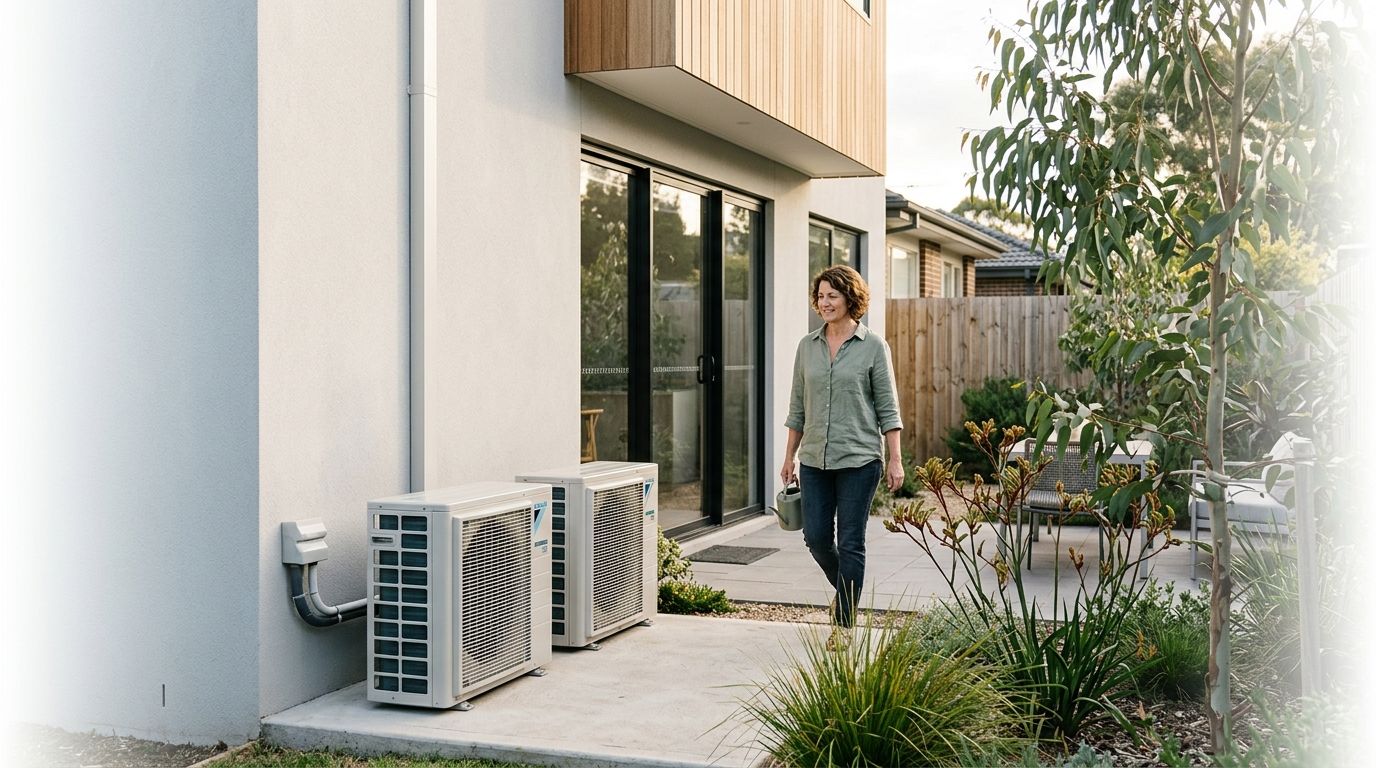
What Is a VRV HVAC System?
A VRV HVAC system is a multi-zone air conditioning technology that connects one outdoor unit to multiple indoor units via a network of refrigerant pipes, allowing each room or zone to be controlled independently. If you manage a strata building in Sydney or run a small business across several offices, a VRV system lets you cool the boardroom, heat the reception and turn off the server room zone entirely, all without tearing up a single ceiling for ductwork.
VRV stands for Variable Refrigerant Volume, a term trademarked by Daikin. The generic industry name for the same technology is VRF, or Variable Refrigerant Flow. Both terms are used interchangeably across the industry and describe a refrigerant-based system where a single outdoor condensing unit serves multiple indoor fan-coil units across a building.
Key takeaways
- VRV HVAC systems connect one outdoor unit to multiple indoor zones for independent control
- Variable-speed compressors deliver precise energy efficiency across commercial and multi-zone buildings
- VRV suits properties where ductwork is impractical or more than five zones are needed
How Does a VRV/VRF System Work?
A VRV/VRF system works by using a variable-speed inverter compressor in the outdoor unit to modulate the flow of refrigerant through a network of copper pipes to each indoor unit. Rather than running at full capacity and cycling on and off like a conventional system, the compressor ramps up or down continuously to deliver exactly the heating or cooling load each zone needs at any given moment. This precision is what separates VRV/VRF from older fixed-speed technology and is the primary reason these systems are so energy efficient at scale. For a deeper look at how inverter compressors work, see our article on inverter technology in air conditioners.
Every VRV/VRF installation has three core components working together:
- The outdoor condensing unit. This houses the inverter compressor, heat exchanger and controls. It is the engine of the whole system and can be sized to serve anywhere from two to 64 indoor units depending on the model.
- The refrigerant pipework and electronic expansion valves (EEVs). Copper refrigerant lines run from the outdoor unit through the building to each indoor unit. Each branch has its own electronic expansion valve that opens or closes to precisely meter refrigerant flow into that zone.
- The indoor fan-coil units. These sit inside each room or zone and come in a range of styles: ceiling cassette, wall-mounted, ducted or floor console. Each unit has its own thermostat and EEV, so it can call for more or less refrigerant independently of every other zone in the building.
Because each indoor unit controls its own refrigerant flow through its expansion valve, zones do not interfere with one another. A meeting room calling for full cooling does not rob refrigerant from a lightly loaded office next door. The outdoor unit simply adjusts its compressor speed to meet the combined demand of all active zones at once.
Heat Pump vs Heat Recovery: What's the Difference?
There are two main VRV/VRF configurations, and choosing the right one matters for how your building actually operates day to day.
A heat pump system runs all indoor units in the same mode at the same time. Every zone is either heating or cooling together. This suits buildings with a consistent thermal load across all rooms, such as a retail shop floor or a single-tenancy office.
A heat recovery system is more sophisticated. It can simultaneously heat some zones while cooling others by capturing heat rejected from the cooling zones and redirecting it to the zones that need warming. Consider a Sydney office on a mild winter morning. The south-facing server room is generating heat and needs cooling, while the north-facing meeting rooms feel cold and need heating. A heat recovery VRV/VRF system handles both demands at the same time, using the waste heat from one zone to warm the other. This makes heat recovery systems significantly more efficient in mixed-use commercial buildings, though they carry a higher upfront cost.

VRV HVAC vs Ducted vs Split Systems: Which Is Right for Your Property?
Sydney property owners typically weigh three main air conditioning approaches: VRV/VRF systems, ducted air conditioning and multi-head split systems. Each suits a different building type, budget and zone count. The right choice depends on how many rooms you need to condition, whether your building can accommodate ductwork and how much upfront cost you can absorb against long-term running savings.
| System Type | Typical Use Case | Approximate Installed Cost (AUD) | Number of Zones | Energy Efficiency | Installation Complexity |
|---|---|---|---|---|---|
| VRV/VRF (e.g. Daikin VRV, Mitsubishi Electric City Multi R2 Series) | Commercial offices, strata buildings, multi-storey homes where ductwork is impractical | $15,000 to $60,000+ | 2 to 64 indoor units per outdoor unit | Very high. COP of 3.5 to 5.0 under part-load conditions | High. Requires Arctick-licensed refrigerant technician and specialist commissioning |
| Ducted AC | Single-family homes, new builds with roof space, whole-home conditioning | $8,000 to $20,000+ | Typically 2 to 8 zones via motorised dampers | Good. Efficiency depends on duct insulation and zone design | Medium to high. Requires roof or underfloor space for ductwork |
| Multi-Head Split System (e.g. Daikin Cora Multi-Head) | Apartments, smaller homes needing 2 to 5 zones without ductwork | $4,000 to $12,000 | 2 to 5 indoor units per outdoor unit | Good. Inverter-driven but less precise load matching than VRV/VRF at scale | Low to medium. Standard electrical and refrigerant work |
VRV/VRF makes the most sense for buildings where ductwork is simply not an option. Strata apartments in North Sydney, heritage commercial buildings in Chatswood and multi-storey offices where ceiling voids are occupied by structural elements are all strong candidates. The Mitsubishi Electric City Multi R2 Series, which uses the VRF label rather than VRV, is a leading alternative to Daikin in these commercial multi-zone applications. If you need more than five zones, want simultaneous heating and cooling in different parts of the building or are managing a body corporate with individual tenant metering requirements, VRV/VRF is the technology to specify. For a detailed breakdown of ducted AC installation costs in Australia, our 2026 price guide covers what to budget across different home sizes.
For single-family homes in suburbs like Wahroonga or Pymble with accessible roof space, ducted air conditioning remains the cleaner, more discreet solution and typically costs less to install than a comparable VRV/VRF system. Smaller budgets or apartments needing just two to four zones are usually better served by a multi-head split system, which delivers solid multi-zone comfort at a fraction of the commercial-grade cost.
Key Benefits and Limitations of VRV HVAC Systems
VRV/VRF systems offer genuine advantages over conventional air conditioning at scale, but they are not the right fit for every property or budget. Understanding both sides of the equation will help you make a clear-headed decision before committing to the investment.
Benefits
- Precise energy efficiency. Because the inverter compressor continuously matches refrigerant output to actual zone demand, VRV/VRF systems typically achieve a coefficient of performance (COP) of 3.5 to 5.0 under real-world part-load conditions. This is significantly better than fixed-speed systems cycling on and off at full capacity.
- Large zone counts from a single outdoor unit. The Daikin VRV 5 Series (RYYQ8T) supports up to 64 indoor units connected to a single outdoor condensing unit. This is the benchmark commercial VRV system AirFlow Australia installs for clients across Sydney's North Shore, with approximate installed pricing starting from $25,000 for a mid-size office fit-out.
- No ductwork required. Refrigerant pipes are small-diameter copper lines that can be routed through walls, ceiling cavities and risers with minimal structural impact. This makes VRV/VRF the preferred solution for heritage buildings in Sydney's Inner West and strata properties where cutting new duct runs is prohibited or impractical.
- Quiet indoor operation. VRV/VRF indoor fan-coil units typically operate at 19 to 26 dB(A), quieter than most split systems and far quieter than ducted grilles at high airflow.
- Long refrigerant pipe runs. Refrigerant can travel up to 165 metres from the outdoor unit to the furthest indoor unit, making VRV/VRF viable for tall commercial buildings and large floor plates where a single outdoor plant location must serve multiple levels.
Limitations
- High upfront cost. Installed pricing typically ranges from $15,000 for a small multi-zone system to $60,000 or more for a large commercial fit-out. This makes VRV/VRF difficult to justify for single-room or small residential applications.
- Specialist installation and servicing required. VRV/VRF systems must be installed and serviced by an Arctick-licensed refrigerant technician. Not every air conditioning company carries the commercial VRV accreditation, so check credentials before engaging a contractor.
- Refrigerant leaks affect multiple zones. Because all indoor units share a common refrigerant circuit, a leak in the pipework can degrade performance across the entire system simultaneously, not just in one room. This is a meaningful operational risk in large buildings.
- Not cost-effective for small applications. If you need to condition one or two rooms in a residential property, a standard split system or multi-head split will deliver comparable comfort at a fraction of the price. VRV/VRF only starts to pay for itself at four or more zones where the efficiency gains and single-outdoor-unit footprint justify the premium.
Is a VRV HVAC System Right for Your Sydney Property?
A VRV/VRF system suits commercial offices, strata buildings, boutique hotels, medical suites and larger multi-storey homes where independent zone control, long refrigerant pipe runs and a single outdoor unit footprint are genuine priorities. If your building has more than five zones, cannot accommodate ductwork or requires simultaneous heating and cooling in different areas, VRV/VRF is the technology to specify.
For most Sydney homeowners with a single-storey or two-storey house, a ducted system or a well-designed multi-head split system will deliver better value. The Daikin Cora Multi-Head Split System (5MXM90) is a strong alternative for homeowners who need multi-zone comfort without the commercial-grade cost of a full VRV installation. Approximate installed pricing starts from $6,500 for a three-zone setup, which is a fraction of the entry price for a comparable VRV system.
AirFlow Australia is Arctick registered and installs Daikin VRV systems across Sydney's North Shore and Inner West. If you are unsure which system suits your property, our team can assess your building, zone count and budget and give you a straight answer. Call us on 0423 535 905 or contact AirFlow Australia for a free quote and we will arrange a site assessment at a time that suits you.
Frequently Asked Questions About VRV HVAC Systems
What does VRV stand for in HVAC?
VRV stands for Variable Refrigerant Volume. It is a term trademarked by Daikin to describe their multi-zone air conditioning technology, where a single outdoor unit supplies refrigerant to multiple indoor units across a building. The compressor modulates refrigerant flow continuously to match the exact heating or cooling demand of each zone.
What is the difference between VRF and VRV?
VRF and VRV describe the same technology. VRV is Daikin's registered trademark, while VRF (Variable Refrigerant Flow) is the generic industry term used by all other manufacturers, including Mitsubishi Electric with its City Multi range. If a contractor or specification document uses either term, they are referring to the same type of multi-zone refrigerant system.
Is VRV better than split AC?
VRV systems outperform standard split systems at scale, particularly where four or more zones are needed from a single outdoor unit or where long refrigerant pipe runs are required. For one to three zones in a residential property, split system air conditioning typically offers better value, simpler servicing and a lower upfront cost. VRV only justifies its premium in commercial or large multi-zone residential applications.
What is the difference between VRF and VFD?
VRF (Variable Refrigerant Flow) and VFD (Variable Frequency Drive) are related but distinct concepts. A VFD is the electronic component inside a VRF system's outdoor unit that varies the compressor motor speed to control refrigerant flow. VRF is the overall system technology. VFD is one of the key components that makes it work. You will sometimes see VFD used in industrial HVAC contexts to describe variable-speed fan or pump drives that are not part of a refrigerant circuit at all.