
What Are Bulkhead Air Conditioners?
Bulkhead air conditioners are ceiling-concealed split systems that sit inside a purpose-built cavity in the ceiling or upper wall, delivering whole-home-style cooling without the extensive ductwork a full ducted system requires. If you own a North Shore apartment or an Inner West terrace and want discreet, powerful climate control, a bulkhead unit is often the most practical solution available to you.
Unlike a wall-mounted split system, a bulkhead unit is hidden entirely within the building structure. The only visible elements are long, slim linear grilles flush with the ceiling. Refrigerant lines connect the indoor air handler to an outdoor compressor, just as they do in a standard split system, but the indoor unit distributes conditioned air through short internal ductwork rather than blowing it directly into the room from a wall-mounted head.
This makes bulkhead systems a genuine middle-ground option. They offer the cleaner aesthetics and broader air distribution of ducted air conditioning, while keeping installation costs and ceiling void requirements much lower. Most units are reverse-cycle as standard, covering both heating and cooling, and available capacities typically run from 2.5 kW up to 14 kW to suit everything from a single bedroom to a large open-plan living area.
Key takeaways
- Bulkhead air conditioners are ceiling-concealed split systems offering discreet climate control for apartments and heritage homes.
- They cost less to install than full ducted systems and require minimal ceiling void depth.
- Multi-zone configurations allow independent temperature control across different rooms.
How Bulkhead Air Conditioners Work
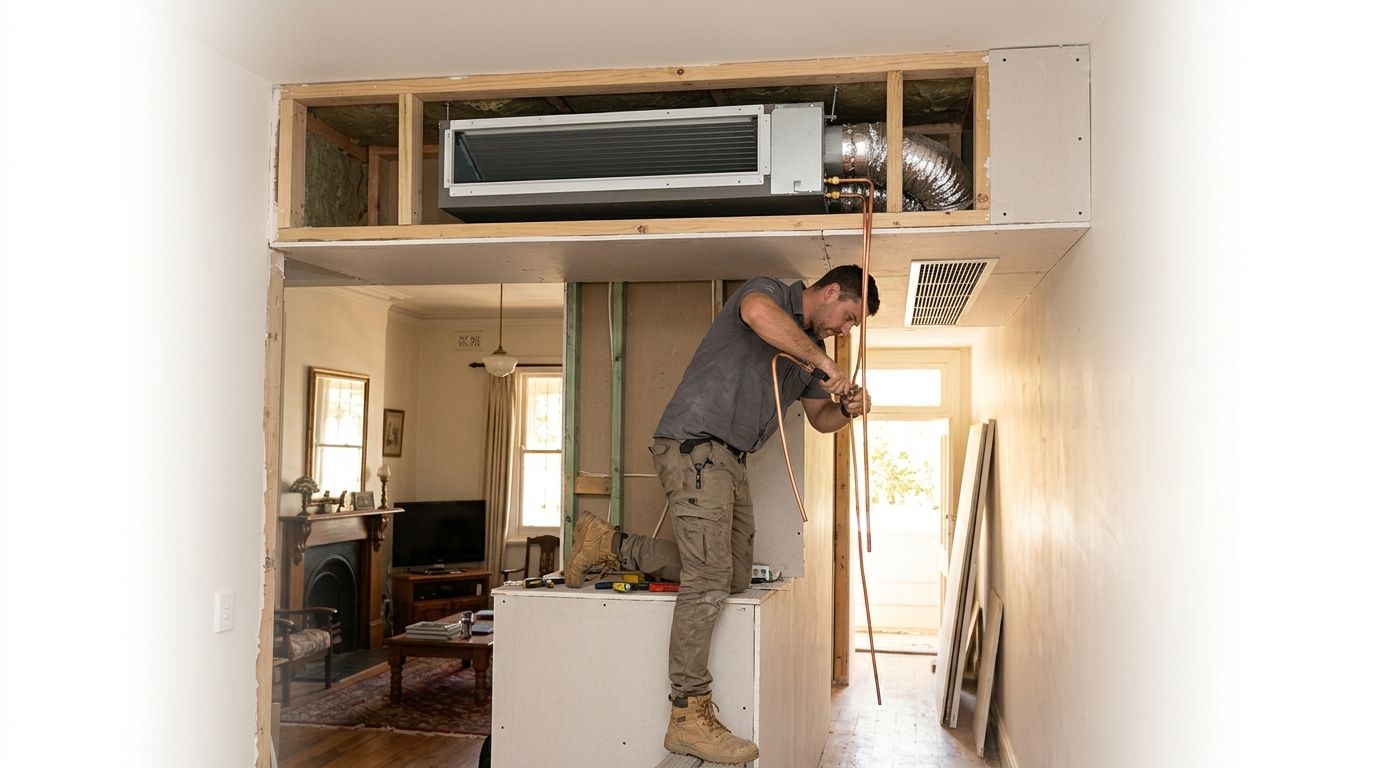
A bulkhead air conditioner has two main components: an indoor ceiling-concealed air handler and an outdoor compressor unit. The indoor unit sits inside a framed bulkhead cavity, typically 200 to 300 mm deep, which a builder or carpenter constructs before the unit is installed. Refrigerant lines and a condensate drain run from the indoor unit through the wall or ceiling void to the outdoor compressor, following the same basic installation path as any split system.
Airflow works like this: the indoor unit draws return air in through an inlet grille, passes it across the evaporator coil to heat or cool it, then pushes the conditioned air out through one or two linear supply grilles positioned along the ceiling. This creates a broad, even spread of air across the room rather than the concentrated stream you get from a wall-mounted head.
One practical detail worth understanding is the return air inlet position. Most bulkhead units offer either a rear-return or a bottom-return configuration. Rear-return suits installations where there is enough ceiling void depth behind the unit to draw air in from the back. Bottom-return is the better choice for tight spaces, such as apartments in Neutral Bay where ceiling voids are shallow, or renovated terraces in Balmain where structural beams limit clearance. Choosing the wrong configuration at the planning stage can complicate installation significantly, so it pays to confirm this with your installer before ordering the unit.
Single-Zone vs Multi-Zone Bulkhead Systems
A single outdoor compressor can connect to multiple indoor bulkhead heads in a multi-split configuration, typically supporting up to four indoor units. Each zone operates independently, so you can cool the open-plan living area while leaving the bedrooms off, or set different temperatures in different parts of the home. This is a meaningful advantage over a fully ducted system, where all zones share a single air handler and zoning is managed through motorised dampers rather than separate refrigerant circuits.
Multi-zone bulkhead setups suit homes with two to four distinct living areas. Federation homes in Wahroonga or Pymble are a good example: a large ground-floor living and dining space, a separate study and two or three upstairs bedrooms each benefit from independent control. Running a single outdoor unit to serve all of those zones keeps the installation tidy and avoids multiple outdoor compressors cluttering the side of the house.
If you are still weighing up whether a bulkhead system, a wall-mounted split or a full ducted setup is the right fit for your home, our guide to split system or ducted air conditioning walks through the key differences in detail.
Pros and Cons of Bulkhead Air Conditioners
Bulkhead air conditioners offer a genuine middle ground between wall-mounted split systems and full ducted installations, but they are not the right fit for every home or budget. The table below lays out the key advantages and trade-offs so you can weigh them against your specific situation before committing to an installation.
| Pros | Cons |
|---|---|
| Fully concealed indoor unit with only slim linear grilles visible | Higher supply and installation cost than a standard split system, typically $3,500–$7,000+ installed depending on capacity and access |
| Broad, even air distribution across the room rather than a concentrated stream | Requires a purpose-built bulkhead cavity, adding carpentry cost on top of the unit and installation price |
| Practical where wall mounting is not possible, such as floor-to-ceiling glazing or heritage-listed interiors | Limited to shorter duct runs serving one to three zones, not a replacement for ducted air conditioning across a whole home |
| Independent zone control in multi-split configurations | Servicing access can be more complex if the bulkhead cavity is not designed with maintenance in mind |
| Quieter indoor operation than most wall-mounted heads | |
| No need for a full ceiling plenum, suits voids as shallow as 200 mm |
The cost premium is the most common sticking point. A bulkhead system costs more upfront than a wall-mounted split, and the carpentry required to frame the cavity adds further to the bill. That said, for Sydney homes with heritage overlays or strata by-laws that prohibit external wall penetrations, a bulkhead system is often the only viable path to discreet, effective climate control. In those situations, the higher cost is not really a trade-off at all. It is simply the price of the only solution that works.
Bulkhead vs Ducted Air Conditioning: Which Should You Choose?
Bulkhead and full ducted systems both conceal the indoor unit from view, but they differ significantly in cost, ceiling space requirements and how many zones they can serve. The comparison below covers the factors that matter most for Sydney homeowners deciding between the two.
| Feature | Bulkhead System | Full Ducted System |
|---|---|---|
| Upfront Cost | $3,500–$7,000+ installed per zone | $8,000–$20,000+ installed for whole home |
| Installation Complexity | Moderate. Requires bulkhead framing and short duct runs | High. Requires accessible roof space and extensive ductwork throughout |
| Ceiling Space Required | 200–300 mm void depth minimum | 400 mm or more typically required for air handler and duct runs |
| Number of Zones | One to four independent zones via multi-split outdoor unit | Four to eight or more zones via motorised dampers from a single air handler |
| Aesthetic Outcome | Slim linear grilles flush with ceiling. Very discreet | Small circular or rectangular diffusers throughout ceiling. Equally discreet |
| Maintenance Access | Requires access panel in bulkhead cavity. Can be tight in shallow installations | Air handler in roof space is generally accessible. Duct cleaning adds ongoing cost |
| Best Suited For | Apartments, semi-detached homes, heritage properties, shallow ceiling voids | Larger homes with accessible roof space and four or more zones to condition |
As a practical guide: choose a bulkhead system if your ceiling void is under 300 mm deep, if strata or heritage restrictions prevent roof space work, or if you only need two to three zones. Apartments and semi-detached homes in Chatswood or Crows Nest are a natural fit. The ceiling voids are shallow, external modifications are often restricted by the owners corporation, and two or three bulkhead units cover the living areas and bedrooms without the complexity of a full ducted installation.
Choose full ducted if your home has an accessible roof space with adequate depth, four or more zones to condition, and the budget to match. Larger homes in Gordon or St Ives with a proper roof cavity are well suited to ducted systems, where a single outdoor unit and one central air handler can serve the whole house through a network of insulated ducts.
If your situation is simpler still, a single open-plan living area or one large bedroom, split system air conditioning is often the most cost-effective path and worth considering before committing to a bulkhead installation.
On running costs, both system types can achieve five-star energy ratings with inverter technology, so the difference in day-to-day electricity use comes down to sizing rather than system type. A correctly sized bulkhead unit will run just as efficiently as a correctly sized ducted system. The key is matching the unit's capacity to the room's heat load, which is why a site assessment before purchase is always worthwhile.
Recommended Bulkhead Air Conditioner Models for Sydney Homes
Three models stand out for bulkhead installations across Sydney's apartments, semi-detached homes and heritage properties. Each suits a slightly different ceiling void depth, room size and budget, so the right choice depends on your specific space. What all three share is inverter technology, which modulates compressor speed to match the room's actual heat load rather than cycling on and off at full power. That keeps running costs lower over a Sydney summer and is worth reading more about if you are comparing energy efficient air conditioners before you buy.
Sizing is critical regardless of which model you choose. An undersized unit will run continuously trying to reach the set temperature, driving up your electricity bill without ever quite getting there. An oversized unit will short-cycle, shutting off before it has run long enough to dehumidify the air properly. Sydney's humid coastal summers make that second problem particularly uncomfortable. A site inspection to measure your ceiling void dimensions and calculate the room's heat load is the only reliable way to confirm the right capacity before you commit to a purchase.
Daikin SkyAir Slim FDA50A (5 kW)
The Daikin SkyAir Slim FDA50A is what we'd recommend for medium-sized living areas, typically 30 to 50 square metres, where ceiling void depth is limited. The indoor unit's slim profile is designed specifically for shallow bulkhead cavities, and the inverter compressor delivers consistent temperature control without the energy spikes of a fixed-speed unit. Approximate installed price for the FDA50A is $4,500 to $6,500, depending on access complexity and the distance to the outdoor unit.
Fujitsu ARTG30LATU Slim Duct (3 kW)
The Fujitsu ARTG30LATU is a compact 3 kW option well suited to apartments and smaller rooms up to around 25 square metres. Its rear-return airflow configuration is a practical advantage in tight ceiling voids where a bottom-return inlet would reduce the usable depth further. Quiet operation makes it a popular choice for bedrooms and studies in Neutral Bay and Cremorne apartments. Approximate installed price sits at $4,000 to $6,000.
Mitsubishi Electric SEZ-M50DA (5 kW)
The Mitsubishi Electric SEZ-M50DA is a reliable 5 kW mid-range choice that sees strong uptake in North Shore homes, particularly in older Federation and inter-war properties where ceiling voids are tight but rooms are generous in size. The low-profile indoor unit depth keeps the bulkhead cavity compact, and the SEZ-M series is compatible with Mitsubishi Electric's multi-zone outdoor units, making it straightforward to expand to additional zones later. Approximate installed price is $4,500 to $6,500.
All three models are available through AirFlow Australia with professional installation across Sydney. Contact us to arrange a site inspection before ordering so we can confirm ceiling void clearances and recommend the correct capacity for your space.
Frequently Asked Questions About Bulkhead Air Conditioners
What is the difference between a bulkhead air conditioner and a ducted system?
A bulkhead air conditioner is a ceiling-concealed split system that sits inside a purpose-built cavity and serves one to three zones through short internal duct runs. A full ducted system uses a single large air handler in the roof space to distribute conditioned air through an extensive duct network across the whole home. Bulkhead systems cost significantly less to install and require far less ceiling void depth, but they cannot match a ducted system's capacity to serve four or more zones from a single unit.
How much does it cost to install a bulkhead air conditioner in Sydney?
Installed prices for bulkhead air conditioners in Sydney typically range from $3,500 to $7,000 or more per zone, depending on the unit's capacity, the complexity of the installation and the access available to the ceiling void. That figure covers the unit, refrigerant line installation, electrical connection and commissioning, but does not include the carpentry required to frame the bulkhead cavity, which adds to the overall project cost.
Can a bulkhead air conditioner heat as well as cool?
Yes. Virtually all bulkhead air conditioners sold in Australia are reverse-cycle units, meaning they provide both heating and cooling from the same system. In heating mode the refrigerant cycle reverses, extracting heat from the outside air and delivering it into the room. This makes them efficient year-round, with modern inverter models achieving high coefficients of performance even on cold Sydney winter mornings.
How much ceiling void space do I need for a bulkhead air conditioner?
Most bulkhead air conditioner indoor units require a ceiling void depth of between 200 and 300 mm, though exact requirements vary by model and manufacturer. Slim-profile units such as the Daikin SkyAir Slim and Mitsubishi Electric SEZ-M series are designed specifically for shallow voids. A site inspection by a qualified installer is the most reliable way to confirm whether your ceiling void can accommodate a bulkhead unit and which return-air configuration suits your space.
Talk to Sydney's Bulkhead Air Conditioning Specialists
Bulkhead air conditioners are an excellent middle-ground solution for Sydney homes where a full ducted system is impractical but a single wall-mounted split system is not enough. If your ceiling void is shallow, your strata rules are restrictive, or your home simply needs more than one zone of discreet climate control, a bulkhead system is very likely the right answer.
AirFlow Australia is fully licensed, Arctick registered and backs every installation with a 5-year workmanship warranty. Our team services the North Shore, Upper North Shore and Inner West, and we carry out bulkhead installations regularly across suburbs from Wahroonga and Pymble through to Balmain and Newtown.
A free site inspection is the best first step. We will measure your ceiling void depth, assess return-air configuration options, calculate the correct capacity for your space and provide a fixed-price quote before any work begins. Call us on 0423 535 905 or book a site inspection online and we will take it from there.