
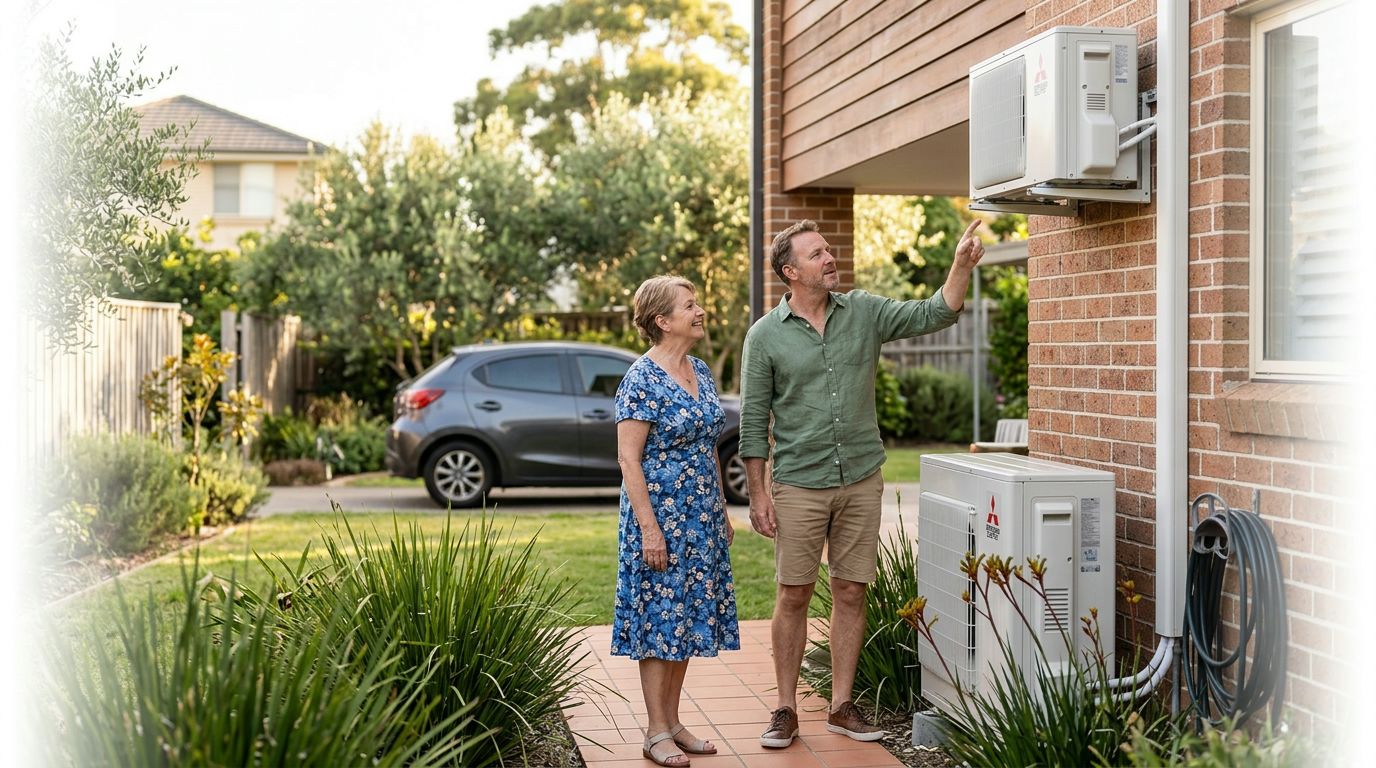
Central AC vs Split System: Understanding the Basics
Sydney summers have a way of forcing the issue. After another week of 38-degree days and restless nights, plenty of homeowners stop tolerating portable fans and window units and start asking a more serious question: central AC or a split system? These are the two main permanent cooling solutions available to Sydney households, and choosing between them comes down to your home's size, layout and how you actually live in it.
Central AC, known locally as ducted air conditioning, uses a single outdoor compressor paired with a central indoor air handler to push conditioned air through a network of ducts and ceiling grilles across the whole home. A split system pairs one outdoor unit with one wall-mounted indoor unit to cool a single room or open-plan area. Both are reverse-cycle, meaning they heat as well as cool.
The Daikin Cora 2.5kW Split System (FTXM25WVMA) is a good example of an entry-level split suited to a bedroom or small living area, with supply-and-install pricing around $1,400 to $1,700. At the other end of the scale, a mid-range option like the Fujitsu General ASTG12KMTC 3.5kW Split System suits a medium-sized living room, with supply-and-install costs typically around $1,800 to $2,200. The rest of this article breaks down exactly when each approach makes sense.
Key takeaways
- Central AC (ducted air conditioning) suits large homes, while split systems work best for apartments and single rooms.
- Ducted systems offer whole-home comfort and zoning control, split systems offer affordability and easy installation.
- Your home type, roof cavity access and budget determine which central AC or split system is right for you.
How Central AC (Ducted Air Conditioning) Works
Ducted air conditioning is the Australian term for what is often called central AC overseas. A single outdoor compressor unit connects to a central air handler, usually installed in the roof cavity or under the floor, which draws air in, conditions it and pushes it out through a network of insulated ducts to ceiling grilles in each room. One system, one thermostat interface, whole-home comfort.
Because all the conditioning happens in one place, ducted systems suit larger homes where running multiple individual units would become impractical and visually cluttered. Suburbs like Wahroonga and Gordon on the Upper North Shore are full of four and five-bedroom Federation and contemporary homes that are ideal candidates. A system like the Daikin Ducted Inverter (FDYQN140LBV1, 14kW) is well matched to a home of this size, with supply-and-install pricing starting from around $12,000 to $16,000 depending on zone count and how complex the duct runs are through the roof cavity.
Installation is more involved than a split system. A licensed installer needs adequate roof cavity access, typically at least 600mm of clearance, to run ductwork and position the air handler. Homes without a suitable roof cavity may require under-floor installation or a purpose-built enclosure, which adds cost and planning time. This is why a site inspection before quoting is essential rather than optional.
Zoning: The Key Advantage of Ducted Systems
Zoning is what separates a well-designed ducted system from simply blasting cold air everywhere at once. The home is divided into independently controlled zones, typically by floor, wing or room grouping, each with its own motorised damper in the ductwork. When the bedrooms are empty during the day, you close that zone and only condition the living areas. At night, you flip it around.
Modern controllers make this straightforward. Daikin's intelligent zoning systems, for example, allow zone control from a wall-mounted touchpad or a smartphone app, so you can adjust settings before you get home. The running cost savings are real. Cooling four rooms instead of eight roughly halves the energy draw for that period. For a large North Shore home running the system daily through a Sydney summer, that difference adds up quickly across a season.
The number of zones you specify at installation affects the upfront cost, but it is almost always worth building in more zones than you think you need. Retrofitting additional zones later requires reopening ductwork, which is disruptive and expensive.
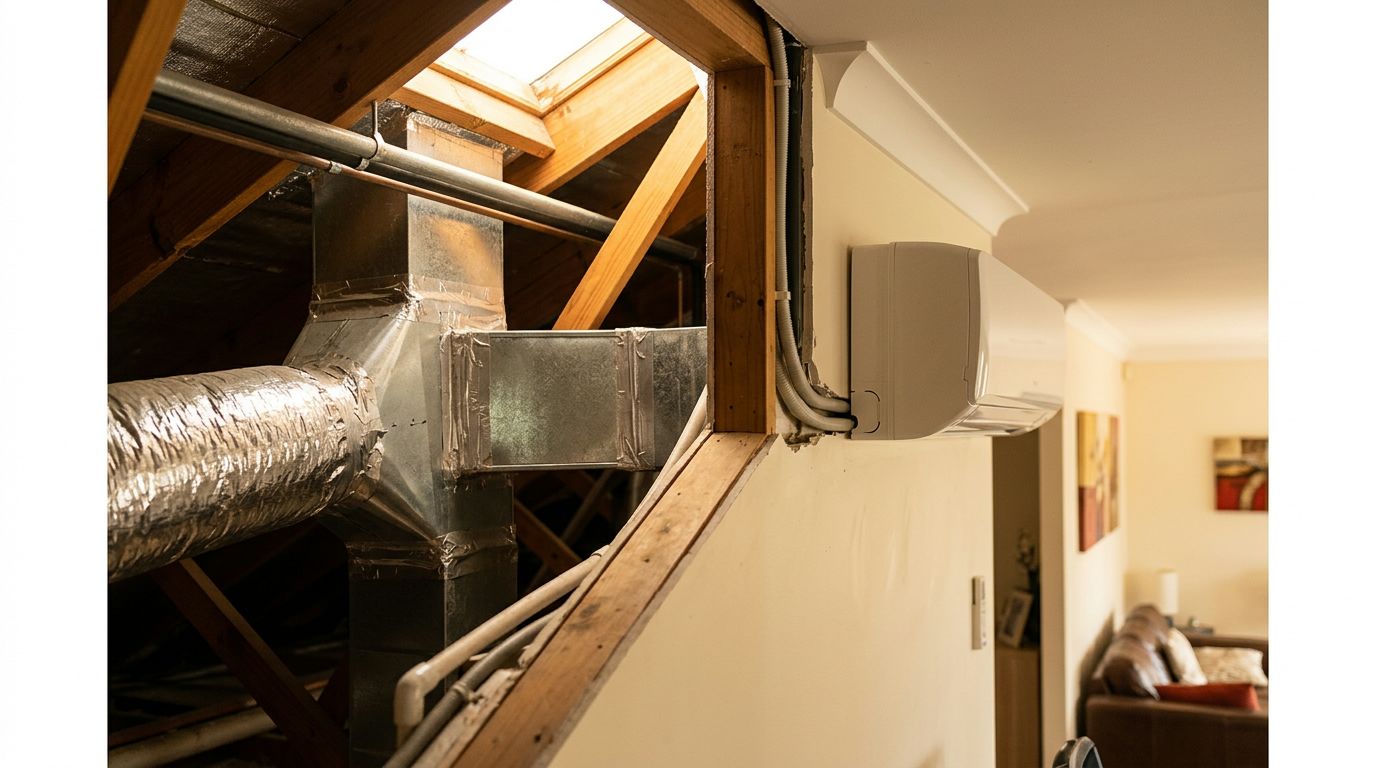
How Split System Air Conditioning Works
A split system air conditioner consists of two units: a wall-mounted indoor head unit inside the room and a compressor unit mounted outside, connected by refrigerant lines and electrical cabling that pass through a small hole in the wall. The indoor unit draws in room air, passes it over a refrigerant coil to cool or heat it, and circulates the conditioned air back into the space. Installation is relatively straightforward and causes minimal disruption to the home.
Every split system sold in Australia is reverse-cycle by default, meaning the same unit handles both cooling in summer and heating in winter. This makes them genuinely year-round appliances rather than single-season purchases. A unit like the Daikin Cora 2.5kW (FTXM25WVMA), priced at around $1,400 to $1,700 supply and installed, is a practical choice for a bedroom or small living area. Step up to a mid-range option like the Fujitsu General ASTG12KMTC 3.5kW and you have enough capacity for a medium-sized living room, typically at $1,800 to $2,200 supply and installed.
Split systems are room-specific by design, which is exactly what makes them the right tool for many Sydney homes. An apartment in North Sydney with one main living area, a terrace in Balmain with a single open-plan ground floor, or an older Federation home in Ashfield where the roof cavity is too shallow for ductwork are all situations where a split system is the practical and cost-effective answer. You condition the rooms you actually use, not the whole house.
Multi-Split Systems: A Middle-Ground Option
A multi-split air conditioner connects multiple indoor units to a single outdoor compressor, letting you serve two, three or even four rooms without running separate outdoor units for each. This is useful in apartments or terraces where outdoor space or body corporate rules limit the number of compressors permitted on the exterior of the building.
The trade-off is cost and flexibility. Multi-split systems are more expensive to supply and install than a single-split unit, and if the outdoor compressor develops a fault, all connected indoor units go down at once. They are a genuine middle-ground option for homes that need more than one room covered but cannot accommodate full ductwork. For whole-home comfort across four or more rooms, a ducted system usually makes more financial sense over the long run.
Central AC vs Split System: A Side-by-Side Comparison
Choosing between ducted and split system air conditioning comes down to six practical factors: what you pay upfront, what installation involves, how well each suits your home type, energy efficiency, zoning flexibility and how much disruption you can tolerate during the install. The table below puts both systems side by side across each of those criteria.
| Criteria | Central AC (Ducted) | Split System |
|---|---|---|
| Supply Cost | $6,000–$14,000+ for the system alone, depending on capacity | $700–$2,500 per unit depending on brand and capacity |
| Installation Cost | $8,000–$20,000+ supply and installed, depending on home size and zone count | $1,200–$4,500 per unit supply and installed |
| Best For | Large homes (4+ bedrooms), new builds, whole-home comfort | Apartments, terraces, older homes, single rooms or open-plan areas |
| Energy Efficiency | High efficiency when zoning is used correctly; less efficient if all zones run simultaneously | Very efficient for targeted room cooling; running multiple units across a home adds up |
| Zoning Capability | Full multi-zone control via motorised dampers; condition only the rooms in use | Each unit is its own zone; no central controller unless a multi-split is used |
| Installation Disruption | Significant: roof cavity access required, ductwork throughout the home, 1–3 days typical | Minimal: small wall penetration, most installs completed in 3–5 hours |
Ducted systems win on whole-home comfort and long-term liveability in larger properties. A system like the Daikin Ducted Inverter (FDYQN140LBV1, 14kW) is well suited to a four or five-bedroom home, with supply-and-install pricing from around $12,000 to $16,000. For anyone building new or undertaking a major renovation where ductwork can be planned from the start, the upfront investment is easier to absorb and the result is a clean, grille-only finish with no wall-mounted units in sight. For a detailed breakdown of what drives those costs, see our guide to ducted AC installation costs in Australia.
Split systems win on affordability, simplicity and suitability for older homes. A Federation terrace in Balmain or a 1960s brick flat in Ashfield rarely has the roof cavity clearance or structural layout to accommodate ductwork without significant and expensive modification. A well-chosen split system installed in the main living area and one or two bedrooms delivers targeted comfort at a fraction of the cost, with installation that wraps up in a single day.
The honest answer for many Sydney households is that neither system is universally better. A large Upper North Shore home with a generous roof cavity and a family that wants whole-home comfort is a ducted job. A two-bedroom apartment in North Sydney or a narrow terrace in Balmain is a split system job. The right choice depends on your floor plan, your budget and how you use your home day to day.
Which System Is Right for Your Sydney Home?
The right air conditioning system for a Sydney home depends on four things: the size of the home, the type of building, how much roof cavity access is available and the budget. Most homeowners fall into one of four common scenarios, and each one points fairly clearly toward either ducted or split system.
Large Family Home on the Upper North Shore
If you own a four or five-bedroom home in Pymble, Turramurra or a similar Upper North Shore suburb, ducted air conditioning is almost always the right call. These homes typically have generous roof cavities, multiple living zones and the kind of floor area where running individual split systems in every room becomes both expensive and visually cluttered. A whole-home ducted system also adds measurable resale value, which matters in a market where buyers expect premium finishes.
Apartment or Strata Property in North Sydney or Neutral Bay
For apartment owners, a split system is almost always the only viable option. Strata by-laws in most North Sydney and Neutral Bay buildings prohibit the ductwork penetrations and roof cavity access that a ducted system requires. A single split system in the main living area, or a multi-split serving the living room and bedroom, covers the realistic cooling needs of most apartments without triggering body corporate issues.
Older Terrace or Federation Home in the Inner West
Terraces and Federation homes in Balmain and Leichhardt present a specific challenge. The roof cavities are often too shallow or too structurally complex to accommodate ductwork without significant and costly modification. A split system or multi-split is the practical answer here. For a detailed look at what installation involves in these older property types, our guide to air conditioning installation in older homes covers the key considerations.
New Build or Major Renovation
If you are building new or undertaking a major renovation, ducted is the easiest system to install. Ductwork can be planned into the ceiling structure from the start, avoiding the access constraints that make retrofitting expensive. The upfront cost is easier to absorb when it sits alongside other construction costs, and the result is a clean finish with no wall-mounted units in sight.
Whichever scenario fits your situation, a site inspection is the essential first step before committing to either system. AirFlow Australia installs both ducted and split systems across Sydney and can assess your roof cavity access, home size and budget before recommending anything.
Ready to Choose? Talk to AirFlow Australia
The best air conditioning system is the one that suits your specific home, not a generic recommendation. Home size, budget, installation feasibility and whether you need whole-home comfort or targeted room cooling are the four factors that matter most. For some Sydney homes the answer is clearly ducted. For others it is clearly a split system. For many, it takes a proper look at the property to be sure.
AirFlow Australia's team services the Inner West, North Shore and Upper North Shore, and we install both ducted and split systems across all of those areas. Call us on 0423 535 905 to arrange a free site inspection and quote. We will assess your home, talk through your options honestly and give you a clear recommendation before you spend a dollar.
Frequently Asked Questions
What is a central air conditioner and how does it work?
A central air conditioner is a ducted system that uses a single outdoor compressor unit and an indoor air handler to push conditioned air through a network of ducts and ceiling grilles, cooling or heating multiple rooms at once. Zoning controls allow different areas of the home to be managed independently, so you only condition the spaces you are actually using. In Australia, these systems are commonly called ducted air conditioners rather than 'central air'.
Will a 2 ton unit cool a 1500 sq ft house?
A 2-ton unit equals roughly 7kW of cooling capacity, which is generally adequate for a home of around 140 square metres in a mild climate. In Sydney's summer heat, or in a poorly insulated home with large west-facing windows, that capacity may fall short. Ceiling height, insulation quality and window orientation all affect the result, so a professional load calculation is always more reliable than a rule of thumb.
What is the $5000 AC rule?
The '$5,000 rule' is a US-originated guideline that suggests multiplying the age of your unit in years by the estimated repair cost, and replacing the system if the result exceeds $5,000 USD. It is a rough heuristic, not an official Australian standard, and the maths does not translate directly to AUD or local labour rates. Sydney homeowners are better served by getting a professional assessment from a licensed technician before committing to either a repair or a full replacement.
What is Fujitsu called now?
Fujitsu General's residential air conditioning products in Australia continue to be sold and marketed under the Fujitsu General brand as of 2026, with no rebrand for the Australian market. Some confusion stems from Fujitsu's broader corporate restructuring internationally, but the air conditioning division operates as a separate entity and the brand name remains unchanged here. AirFlow Australia installs and services Fujitsu General systems across Sydney.