

How Does Split System Air Conditioning Work? The Short Answer
It's 38°C on a January afternoon and your North Shore terrace has turned into an oven. You hit the remote, hear a soft hum from the wall unit, and within minutes the room drops to a comfortable 24°C. But how does split system air conditioning actually pull that off? The short answer is that it doesn't generate cold air. It moves heat, shifting it from inside your home to the outside air.
This guide covers the four things Sydney homeowners most often ask about: the two physical components that make up the system, the refrigeration cycle that does the heavy lifting, how the same unit heats your home in winter, and what to look for when you're ready to buy.
Key takeaways
- Split system air conditioning works by moving heat using a refrigeration cycle, not generating cold air.
- The system comprises an indoor evaporator unit and outdoor compressor unit connected by refrigerant lines.
- Reverse-cycle models provide both cooling and heating, delivering 3 to 5 times more energy than they consume.
The Two Main Components: Indoor Unit and Outdoor Unit
A split system air conditioning unit consists of two main components joined by a refrigerant circuit: an indoor wall-mounted unit and an outdoor compressor unit. The system gets its name from this physical split. The two units are connected by insulated copper refrigerant lines and electrical cabling that pass through a small core hole drilled in the wall, typically 65 to 75 mm in diameter. In Sydney apartments and terraces, where the outdoor unit might sit on a balcony, a rooftop, or along the side of a building, the placement of that outdoor unit is often the first practical question an installer needs to solve.
Under Australian law, only an Arctick-registered technician is permitted to handle refrigerant, so split system installation is not a DIY job. A licensed installer will assess your wall structure, run the refrigerant lines, pressure-test the circuit and commission the system correctly, which protects both your warranty and your safety.
Indoor Unit: Where the Magic Happens
The indoor unit is the slim, wall-mounted panel you see inside the room. Its job is to draw warm room air across a cold evaporator coil. As the air passes over the coil, heat from the air is absorbed into the refrigerant flowing through it. The now-cooled air is then pushed back into the room by the unit's fan. A thermistor (a small temperature sensor) reads the room air and signals the system to adjust output accordingly.
Inside the unit sits an air filter, usually a washable mesh screen, that catches dust, pet hair and airborne particles before they reach the coil. A clogged filter forces the fan to work harder, reduces airflow across the coil and cuts efficiency noticeably. Cleaning the filter every four to six weeks during heavy use is one of the simplest things you can do to keep running costs down and maintain good air quality in your home.
Outdoor Unit: Where the Heat Goes
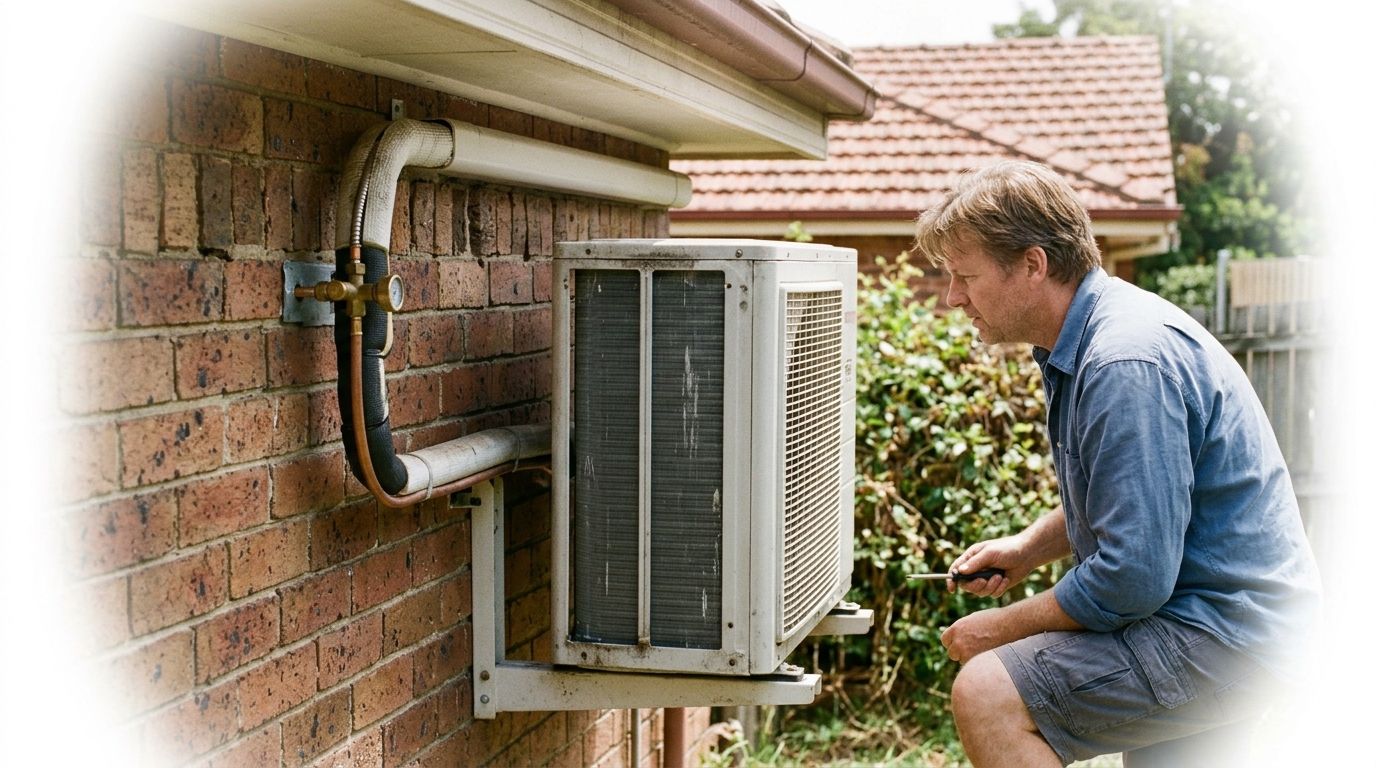
The outdoor unit is where the heat extracted from your room is released to the outside air. The compressor, the heart of the system, pressurises the refrigerant gas, raising its temperature significantly. That hot, high-pressure refrigerant then flows through the condenser coil, where the outdoor fan draws ambient air across the coil and carries the heat away. An expansion valve then drops the refrigerant's pressure and temperature before it cycles back inside to absorb more heat.
This is why the outdoor unit always blows warm air on a hot day. It's not a malfunction, but the system doing exactly what it's designed to do: dumping the heat it has pulled out of your living room into the outside air. On a 35°C Sydney afternoon, the air coming off the condenser can be considerably hotter than the ambient temperature, which is also why outdoor unit placement and adequate airflow clearance around the unit matter for long-term performance.
The Refrigeration Cycle: How Heat Is Moved, Not Made
A split system air conditioner does not generate cold air. It moves heat from one place to another using a continuous loop of refrigerant that alternates between liquid and gas states. The same basic principle is at work in your kitchen fridge, which is why the back of a fridge feels warm: it is releasing the heat it has pulled out of the food compartment. A split system does exactly the same thing, just on a larger scale and across two separate units.
Here is how the four-stage cycle works in plain English:
- Evaporation. Liquid refrigerant flows into the evaporator coil inside the indoor unit. The refrigerant is kept at a very low pressure, which means it boils and evaporates at a low temperature. As it evaporates into a gas, it absorbs heat energy from the warm room air passing over the coil. The air loses its heat to the refrigerant and exits the unit noticeably cooler.
- Compression. The refrigerant gas travels through the refrigerant lines to the outdoor unit, where the compressor pressurises it. Compressing the gas raises its temperature significantly, often to well above the outdoor ambient temperature. This is the step that makes it possible to dump heat outside even on a warm day.
- Condensation. The hot, high-pressure gas passes through the condenser coil in the outdoor unit. The outdoor fan draws ambient air across the coil, and the refrigerant releases its heat into that airstream. As it loses heat, the gas condenses back into a liquid. This is why the air blowing off your outdoor unit feels warm.
- Expansion. The liquid refrigerant passes through an expansion valve, which causes a rapid drop in pressure and temperature. The now-cold liquid flows back to the indoor evaporator coil, and the cycle begins again.
Modern split systems use an inverter compressor, which varies its speed continuously to match the actual heating or cooling load rather than switching fully on and off. A fixed-speed compressor is like a car that can only drive at full throttle or stop completely. An inverter compressor is like cruise control: it finds the right speed and holds it, using far less energy in the process. Read more about inverter technology and why it matters for your energy bills.
Cooling Mode vs Heating Mode: How Reverse Cycle Works
Almost every split system sold in Australia today is a reverse-cycle unit, meaning it can both cool in summer and heat in winter using the same refrigerant circuit. In cooling mode, heat is extracted from inside and released outside. In heating mode, a component called a reversing valve flips the direction of the cycle so that the outdoor unit absorbs heat from the outside air and transfers it indoors.
This surprises many people. Even on a cold Sydney winter morning at 8°C, there is still usable heat energy in the outside air. The refrigerant, kept at a lower temperature than the outdoor air, can absorb that energy and carry it inside. The compressor then raises the refrigerant's temperature further before releasing the heat into the room.
The efficiency advantage over a resistive electric heater is substantial. A standard electric bar heater converts 1 kW of electricity into 1 kW of heat. A good reverse-cycle split system delivers 3 to 5 kW of heat for every 1 kW of electricity it consumes. This ratio is called the Coefficient of Performance, or COP. A COP of 4 means you are effectively getting four times the heat output for the same electricity spend.
| Heating Method | Electricity Input | Heat Output | COP |
|---|---|---|---|
| Electric bar heater | 1 kW | 1 kW | 1.0 |
| Reverse-cycle split system (typical) | 1 kW | 3 to 5 kW | 3.0 to 5.0 |
For Sydney homes, this dual function is the main reason split systems dominate the market. Sydney summers regularly push past 35°C, and winters on the Upper North Shore and in the Hills District can drop to single digits overnight. A single reverse-cycle unit handles both seasons without needing separate heating and cooling appliances. The terminology around this can be confusing, since some retailers use 'split system' and 'reverse cycle' as if they mean different things. For a full breakdown, see our guide on split system vs reverse cycle air conditioning.
What to Look for When Choosing a Split System for Your Sydney Home
Choosing the right split system comes down to five practical factors: capacity, energy rating, inverter technology, noise output and brand reliability. Get these right and the unit will run efficiently for 10 to 15 years. Get them wrong and you will either be sweating through a Sydney summer with an undersized unit or paying inflated electricity bills because an oversized one short-cycles and never properly dehumidifies the room.
Capacity: Getting the kW Right
Capacity is measured in kilowatts and should be matched to the room size, ceiling height, insulation quality and sun exposure of the space you are cooling. As a rough starting guide:
| Room Type | Approximate Size | Recommended Capacity |
|---|---|---|
| Small bedroom | Up to 20 m² | 2.5 kW |
| Master bedroom or study | 20 to 30 m² | 3.5 kW |
| Medium living area | 30 to 45 m² | 5.0 kW |
| Large open-plan living area | 45 m² and above | 7.1 to 8.0 kW |
An undersized unit runs continuously and never reaches the set temperature. An oversized unit cools the air too quickly, shuts off before it has had time to remove humidity, and leaves the room feeling clammy. A licensed installer can do a proper heat load calculation for your specific home.
Energy Star Ratings
The more stars, the lower the running cost. Each additional star represents roughly a 10% improvement in efficiency. For a unit running six to eight hours a day through a Sydney summer, the difference between a three-star and a five-star model adds up quickly over the life of the system.
Inverter vs Non-Inverter
Always choose an inverter model. As explained earlier in this guide, inverter compressors vary their speed to match the load rather than switching fully on and off. They are quieter, more efficient and reach the set temperature faster. Non-inverter units are cheaper upfront but cost more to run every single day.
Noise Levels
For bedrooms and apartments, indoor noise levels matter. Look for units rated at or below 20 dB(A) on their lowest fan setting. At that level, the unit is quieter than a whisper and will not disturb sleep.
Brand Reliability
AirFlow Australia installs and recommends Daikin, Fujitsu and Mitsubishi Electric as the three most reliable brands for Sydney conditions. For a small bedroom, the Daikin Cora FTKM25VVMA (2.5 kW) is a strong entry-level choice, priced at around $1,100 to $1,300 supply-only, with a five-star energy rating and an indoor noise level of approximately 19 dB(A). For apartments on the North Shore where wall space is limited, the Fujitsu Classic Plus ASTG09KMCA (2.5 kW) is worth considering for its compact indoor unit profile. For medium to large open-plan living areas, particularly in Upper North Shore homes where winter heating is also a priority, the Mitsubishi Electric MSZ-AP50VGD (5.0 kW) is a standout option thanks to its Hyper Heating capability, which maintains strong heating output even when outdoor temperatures drop to near zero.
Whichever model you choose, professional installation is essential. It protects your manufacturer warranty, ensures the refrigerant circuit is correctly charged and pressure-tested, and keeps you compliant with Australian regulations. Find out what to expect during a split system installation before you book.
Frequently Asked Questions
What is the $5000 rule for AC?
The $5,000 rule is a repair-versus-replace guideline: multiply the age of your unit in years by the cost of the repair quoted. If the result exceeds $5,000, replacement is generally more cost-effective than repair. The rule originated in the US, so Australian homeowners should also weigh the energy efficiency gains of a new inverter model against the full cost of supply and installation. A professional assessment from a licensed technician will give you the clearest picture before you commit either way.
Which is colder, 24C or 16C in AC?
16°C is colder. On an air conditioner, a lower set temperature means the unit will cool the room to a lower target temperature. Setting the thermostat to 16°C forces the system to work harder and run longer to reach that point, which increases energy consumption noticeably. For comfort and efficiency, 24°C is the recommended cooling set point for most Australian homes.
How does a wall AC unit work?
A wall-mounted split system works by circulating refrigerant between the indoor and outdoor units. The indoor unit draws warm room air across a cold evaporator coil, absorbing heat from the air into the refrigerant. That heat is carried to the outdoor unit, compressed and expelled outside, while the cooled air is blown back into the room. This is the same vapour-compression refrigeration cycle described throughout this article.
What is the working principle of an air conditioner?
All air conditioners, including split systems, ducted systems and portable units, operate on the vapour-compression refrigeration cycle. They move heat from one place to another using a refrigerant that alternately evaporates (absorbing heat) and condenses (releasing heat). They do not generate cold air; they remove heat from the indoor air and expel it outside. Reverse-cycle models can run this process in reverse, absorbing heat from the outdoor air and transferring it indoors to provide efficient heating.
Ready to Install a Split System in Your Sydney Home?
A split system works by moving heat, not manufacturing cold air. A modern reverse-cycle inverter model does this with remarkable efficiency, delivering three to five times more heating or cooling energy than the electricity it consumes. Get the capacity right, choose a reliable brand and have the system installed by an Arctick-registered technician, and you will have a unit that handles Sydney summers and North Shore winters comfortably for well over a decade.
AirFlow Australia supplies and installs split systems across Sydney's Inner West and North Shore, including suburbs like Balmain, Leichhardt, Mosman, Chatswood and Wahroonga. Our technicians are fully licensed to handle refrigerant and will size the system correctly for your specific home before a single hole is drilled.
To get a free quote or book a site inspection across our Sydney service areas, call us on 0423 535 905 or send an enquiry through our website. We will get back to you promptly.