
Split System vs Reverse Cycle: Why the Confusion Exists
You're browsing air conditioners online for your Sydney home, and within five minutes you've seen the terms 'split system', 'reverse cycle', 'inverter', and 'heat pump' used almost interchangeably. It's genuinely confusing, and you're not alone in finding it that way. The short answer to the split system vs reverse cycle air conditioning question is this: they are not competing categories. 'Reverse cycle' describes a technology, and 'split system' describes a physical form factor.
A reverse cycle system is any air conditioner that can both cool and heat by reversing its refrigeration cycle. A split system is any unit where the components are split across two parts: an indoor wall-mounted unit and an outdoor compressor unit. Most split systems sold in Australia today are reverse cycle, which is exactly why the terms get used as though they mean the same thing.
This article unpacks how the two terms overlap, where they genuinely differ, and what that means for choosing the right system for a Sydney home.
Key takeaways
- Split system and reverse cycle are not the same thing, though most split systems sold in Australia are reverse cycle units
- Reverse cycle technology moves heat rather than creating it, delivering three to four times the heating efficiency of electric heaters
- Your choice depends on room size, home layout and whether you need single-room or whole-home climate control
What Does 'Reverse Cycle' Actually Mean?
Reverse cycle is a heat pump technology that allows an air conditioner to both cool and heat a space using the same refrigerant circuit. Rather than generating heat by burning fuel or using a resistive electric element, a reverse cycle system moves heat from one place to another. In summer it moves heat out of your home. In winter it moves heat in. This distinction matters because moving heat is far more efficient than creating it.
A standard electric bar heater or panel heater converts one unit of electricity into one unit of heat. A reverse cycle system, by contrast, typically delivers three to four units of heat energy for every one unit of electricity it consumes. This ratio is known as the Coefficient of Performance, or COP, and a COP of 3 to 4 is the norm for quality reverse cycle units operating in Sydney's mild winter conditions. In practical terms, that means running costs roughly a quarter of what you'd pay with resistive electric heating for the same warmth.
This efficiency advantage is the primary reason reverse cycle has become the dominant heating and cooling technology in Australian homes. It works well in our climate, it handles both seasons with a single unit, and it costs significantly less to run than the alternatives. For readers who want to explore star ratings, zoning and annual running costs further, our guide to energy efficient air conditioners in Australia covers the full picture.
Cooling Mode vs Heating Mode: How the Cycle Reverses
The key component that makes reverse cycle possible is a reversing valve inside the outdoor unit. This valve changes the direction refrigerant flows through the system, which swaps the roles of the indoor and outdoor coils.
In cooling mode, the indoor coil acts as the evaporator. Refrigerant absorbs heat from the air inside your home, carries it outside, and releases it through the outdoor coil. Your room cools down, and the heat ends up outside where it belongs on a 35-degree Sydney afternoon.
In heating mode, the reversing valve switches direction. Now the outdoor coil becomes the evaporator, absorbing heat energy from the outside air even when temperatures drop to around -15°C. That heat is carried inside and released through the indoor coil, which now acts as the condenser. The result is warm air delivered into your room without a single flame or heating element involved. It sounds counterintuitive to extract heat from cold air, but there is always thermal energy present in air above absolute zero, and modern reverse cycle systems are very good at capturing it.
What Is a Split System and How Does It Differ?
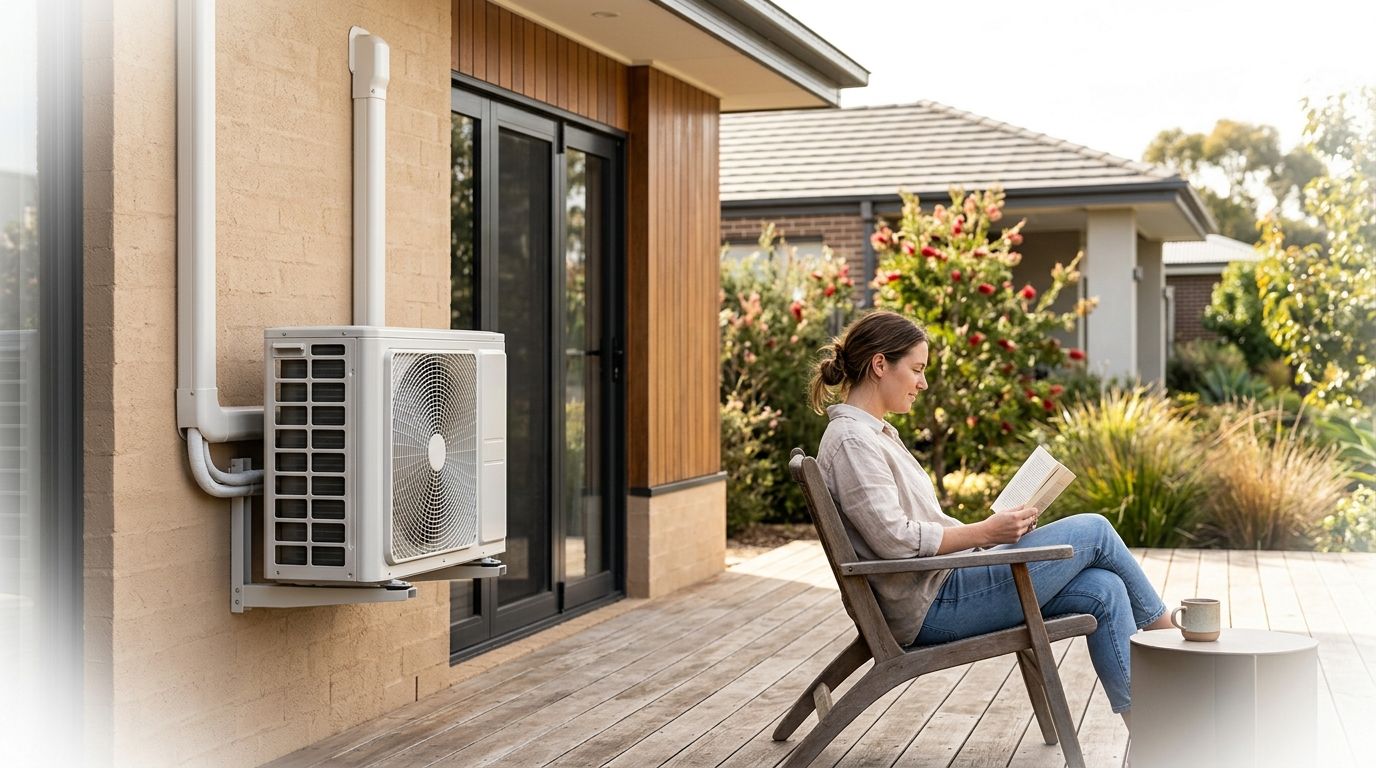
A split system air conditioning unit is defined by its physical form: one indoor wall-mounted unit connected via refrigerant lines through a small wall penetration to one outdoor compressor unit. The vast majority of split systems sold in Australia today are reverse cycle, meaning they both heat and cool. However, not every reverse cycle system is a split system. Ducted air conditioning also uses reverse cycle technology, with the same heat pump principle driving a central unit that distributes conditioned air through ceiling vents across multiple rooms.
The table below shows exactly where the two terms overlap and where they part ways.
| Feature | Split System | Reverse Cycle |
|---|---|---|
| Definition | A physical configuration: indoor unit plus outdoor compressor | A technology: heat pump that both heats and cools |
| Physical form | Wall-mounted indoor head, separate outdoor unit | Can be split system, ducted, cassette or multi-head |
| Heating capability | Yes, if reverse cycle (most are); no, if cool-only | Always yes, by definition |
| Cooling capability | Always yes | Always yes |
| Typical installed cost range | $1,400 to $3,500 for a single-room unit | $1,400 to $15,000+ depending on system type |
| Best suited for | Single rooms, apartments, targeted zone cooling and heating | Any home or space requiring efficient year-round climate control |
Cool-Only Split Systems: Are They Still Available?
Cool-only split systems do still exist, but they are increasingly rare in the Australian residential market. You will occasionally see them specified for server rooms, commercial kitchens or data centres where heating is never required and a lower upfront unit cost is the priority. For the vast majority of Sydney homeowners, a reverse cycle split system is the standard recommendation. The price difference between cool-only and reverse cycle has narrowed considerably, and the ability to heat efficiently through Sydney's mild winters makes reverse cycle the obvious choice for almost every household application.
Which System Is Right for Your Sydney Home?
For most Sydney households, a reverse cycle split system covers the brief well. It handles the city's hot, humid summers and mild winters with a single unit, installs in a day without ductwork, and costs a fraction of a full ducted system. The right choice comes down to your home's layout, room sizes and how many spaces you need to condition. Here are three common Sydney scenarios to help you work out which direction to go.
Single room or open-plan apartment. A reverse cycle split system is the natural fit. There is no ductwork to run, installation is straightforward, and a single outdoor unit sits neatly on a balcony or external wall. For a small apartment bedroom or studio up to around 20m², the Daikin Cora 2.5kW (FTXM25Y) is a reliable entry-level choice with an approximate installed price of $1,400 to $1,700. For a larger open-plan living and dining area, the Mitsubishi Electric MSZ-AP Series 3.5kW steps up the capacity and suits the open-plan layouts common in North Shore homes, with an approximate installed price of $1,800 to $2,200.
Multi-room home in suburbs like Wahroonga or Gordon. Here the decision gets more nuanced. A multi-head split system lets you run two or three indoor units from a single outdoor compressor, which suits homes where you want independent control in the main bedroom, a second bedroom and a living area. Alternatively, a ducted reverse cycle system offers whole-home coverage with a cleaner aesthetic. If you are weighing up those two paths, our article on split system or ducted air conditioning walks through the trade-offs in detail.
Older terrace homes in Balmain or Newtown. Terraces often have shallow ceiling cavities that make ducted systems impractical or prohibitively expensive to retrofit. A split system is frequently the only workable option. For bedrooms in these homes where noise is a real concern, the Fujitsu ASTG09KMCA 2.5kW is worth considering. Its indoor unit operates at below 19dB, making it one of the quietest options in its class, with an approximate installed price of $1,500 to $1,900.
Sydney's climate sits in a sweet spot for reverse cycle efficiency. Summers are hot and humid but rarely extreme enough to push a quality inverter unit to its limits, and winters are mild enough that the outdoor coil can extract heat from the air with minimal effort. That means high efficiency ratings translate into real savings on your electricity bill year-round.
AirFlow Australia installs Daikin, Fujitsu, Mitsubishi Electric, LG and Samsung systems across Sydney, and our team can advise on the right capacity and model for your specific room and layout.
Key Factors to Consider Before You Buy
Four factors will shape your decision more than any other.
- Room size and kW capacity. As a general guide, rooms up to 20m² need around 2.5kW, rooms between 20m² and 40m² need 3.5 to 5kW, and rooms between 40m² and 60m² need 6 to 7kW. Open-plan spaces with high ceilings or large north-facing windows may need to step up a size.
- Energy star rating. More stars means lower running costs. In Sydney's climate, a unit you run for eight months of the year will repay a higher star rating quickly. Check both the cooling and heating star ratings on the Energy Rating Label.
- Noise level. For bedrooms, look for indoor units rated below 40dB on their lowest fan speed. Some models, like the Fujitsu ASTG09KMCA, go well below that threshold, which matters if you are a light sleeper.
- Installation complexity. Wall type (brick, weatherboard or cavity), pipe run length from indoor to outdoor unit, and outdoor unit placement all affect installation cost and time. A longer pipe run or a difficult outdoor unit location can add $200 to $500 to the installed price.
Frequently Asked Questions
Is a split system the same as a reverse cycle air conditioner?
Not exactly, though the terms are often used interchangeably in Australia. A split system describes the physical form of the unit: one indoor head and one outdoor compressor connected by refrigerant lines. Reverse cycle describes the technology that allows a system to both heat and cool. Most split systems sold in Australia today are reverse cycle, so in practice the two terms usually refer to the same product.
Can a split system heat as well as cool?
Yes, provided it is a reverse cycle model, which covers the vast majority of split systems available in Australia. A reverse cycle split system uses a heat pump to move heat into your home in winter and out of it in summer. For Sydney's mild winters, this is far more efficient than a resistive electric heater, typically delivering three to four units of heat for every one unit of electricity consumed.
What is the difference between a reverse cycle and a heat pump?
They are the same thing described from different angles. A heat pump is the underlying technology: a refrigerant circuit that moves thermal energy from one place to another rather than generating it. Reverse cycle is the term the Australian air conditioning industry uses to describe a heat pump system that can reverse its refrigerant flow to switch between heating and cooling modes.
How much does a reverse cycle split system cost to install in Sydney?
Installed prices in Sydney typically range from around $1,400 for an entry-level 2.5kW unit up to $3,500 or more for a larger capacity model in a complex installation. The final cost depends on the brand, capacity, wall type and the length of the pipe run between the indoor and outdoor units. For a detailed breakdown, our guide to aircon and installation cost in Australia covers what to expect at each price point.
Ready to Install a Reverse Cycle Split System in Sydney?
The key takeaway from this article is straightforward: for most Sydney homes, a reverse cycle split system is the most practical, energy-efficient and cost-effective way to handle both summer cooling and winter heating with a single unit. The two terms overlap almost completely in the Australian residential market, and understanding that overlap makes choosing the right system much simpler.
AirFlow Australia is fully licensed, Arctick registered and backs every installation with a five-year installation warranty. Our team services suburbs across the Inner West and North Shore, from Balmain and Newtown through to Wahroonga and Gordon. To get started, book a split system installation or call us directly on 0423 535 905 to discuss your home and get a free quote.