
Why Regular Maintenance of Your AC Unit Matters
Imagine it's the first genuinely hot day of summer on Sydney's North Shore. You point the remote at your split system, press 'cool', and wait. Instead of that familiar rush of cold air, you get a weak, stale trickle that barely shifts the temperature. The unit has been sitting idle since March and nobody has touched it since. This is exactly why routine maintenance of your AC unit is not something you can put off until something goes wrong.
A neglected air conditioner can lose up to 25% of its operating efficiency, which shows up directly on your electricity bill. Worse, the strain of running in a degraded state shortens the compressor's lifespan, turning what should be a 10 to 15 year investment into a costly early replacement.
The good news is that most of the work is straightforward. This article walks through a practical checklist broken into three timeframes: monthly tasks you can do yourself, seasonal checks before summer and winter, and annual professional servicing that keeps your warranty intact and your system running at full capacity.
Key takeaways
- Regular maintenance of your AC unit prevents efficiency loss and extends system lifespan by years.
- Monthly filter cleaning and outdoor unit checks are simple tasks any homeowner can perform.
- Annual professional servicing by a licensed technician is essential to maintain warranty coverage.
Your Monthly AC Maintenance Checklist
Spending 15 minutes on your air conditioner each month prevents the slow decline that catches most homeowners off guard. These five tasks require no tools and no technical knowledge, just a bit of consistency.
- Remove and rinse the indoor unit's air filters. Slide out the mesh filters from behind the front panel and rinse them under lukewarm water until the water runs clear. Allow them to air-dry completely before reinserting. During heavy-use periods like summer, Daikin, Fujitsu and Mitsubishi Electric all recommend cleaning their user-removable filters every two to four weeks. A clogged filter is the single fastest way to choke airflow and push up running costs.
- Wipe down the louvres and casing. Use a damp cloth to clean the front panel, louvres and any visible vents on the indoor unit. Dust and grime build up quickly in Sydney homes, particularly in suburbs close to main roads or construction activity.
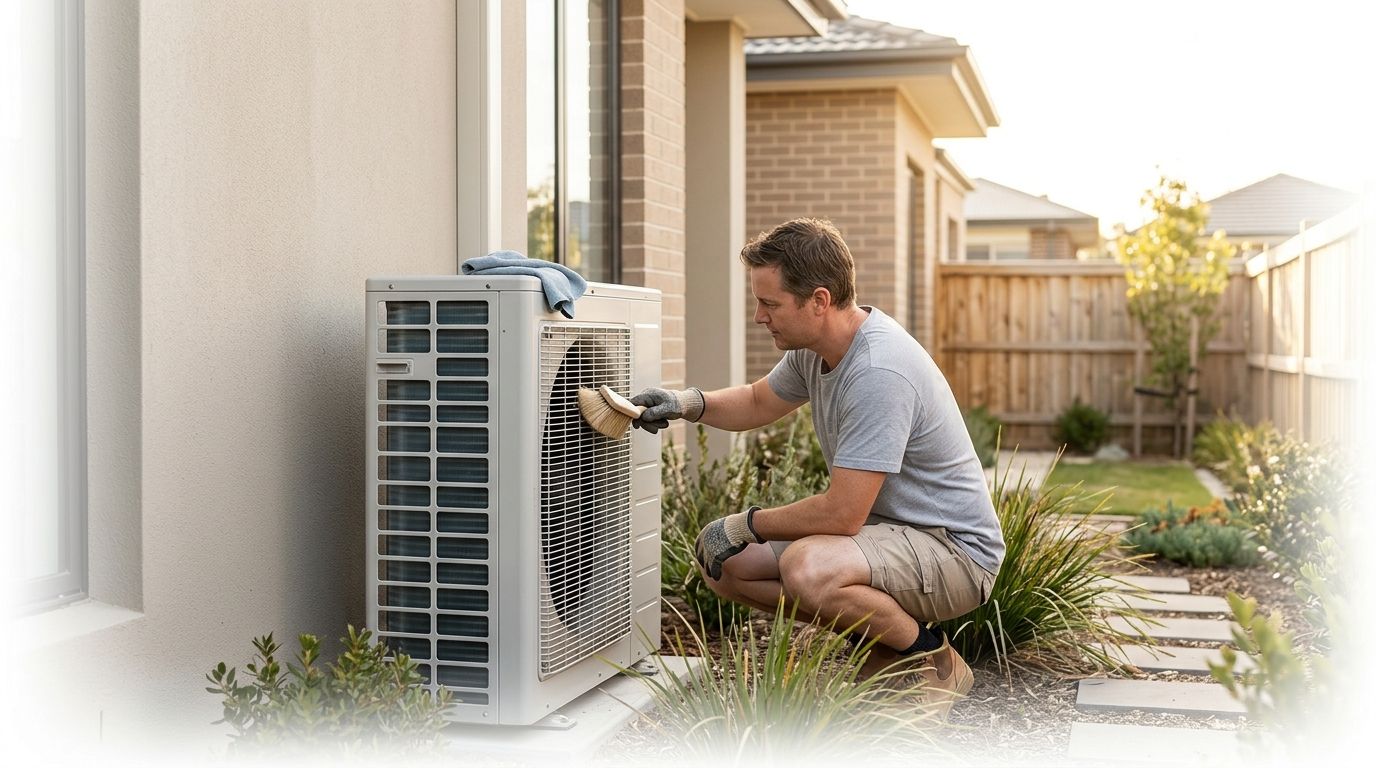
- Check the outdoor unit's clearance. Walk outside and inspect the condenser unit. Clear away any leaves, debris or overgrown vegetation. The unit needs at least 500 mm of clear space on all sides to draw in and expel air properly. Restricted airflow forces the compressor to work harder and raises running costs.
- Inspect the condensate drain tray. Look for standing water, slime or mould around the drain outlet. A blocked condensate drain can cause water to back up into the unit and eventually drip through your ceiling or wall, which is a repair bill nobody wants.
- Test the remote and check the set temperature. Set the unit to a specific temperature and give it 10 to 15 minutes. If it is struggling to reach the target or cycling on and off frequently, that is a sign something needs attention before the problem gets worse.
How to Clean Your AC Filters at Home
Cleaning your filters is the single highest-impact maintenance task a homeowner can do, and it takes less than 10 minutes. Skipping it is the most common cause of reduced airflow, ice build-up on the coil and higher running costs across all brands and models.
- Turn the unit off at the remote and wait a few minutes for the fan to stop completely.
- Open the front panel by lifting it upward or unclipping the tabs, depending on your model.
- Slide the mesh filter frames out carefully. Most split systems have two filters sitting side by side.
- Rinse the filters under cool running water. Never use hot water, as it can warp the mesh frame. Do not scrub with a brush, as this can damage the fine mesh.
- Shake off excess water and leave the filters to air-dry in the shade for at least 30 minutes. Direct sunlight can cause warping.
- Reinsert the dry filters, close the panel and power the unit back on.
DIY filter cleaning is a great habit, but it only addresses the surface layer of the system. The evaporator coil, blower wheel and drain pan sit deeper inside the unit and accumulate mould, bacteria and compacted dust that a rinse under the tap cannot reach. AirFlow Australia's professional cleaning service covers a full coil and blower wheel clean using specialised equipment, which restores airflow and air quality to near-new levels. For a closer look at what a thorough clean involves, read our guide to cleaning your air conditioner.

Seasonal AC Maintenance: What to Check Before Summer and Winter
Sydney's climate puts specific pressure on air conditioning systems that many other cities simply don't face. Humid summers push units hard for months at a stretch, while mild but damp winters create ideal conditions for mould growth inside idle indoor units. Booking a professional inspection twice a year, once in October before summer and once in May before winter, is the most reliable way to stay ahead of both. A professional service for a split system typically costs between $150 and $250. For a full breakdown of what affects that price, see our guide on how much it costs to service an air conditioner in Australia. AirFlow Australia carries out seasonal servicing across the North Shore, Inner West and Upper North Shore.
Pre-Summer Checks (October)
October is the right time to confirm your system is ready before temperatures climb and demand on the unit peaks. Running through these checks early gives you time to book a technician if something needs attention, rather than scrambling during a heatwave.
- Test cooling mode and confirm the unit reaches target temperature. Set the unit to 24°C and run it for 20 minutes. If the room temperature is not dropping toward the set point, the system may have a refrigerant or airflow issue that needs professional attention before summer.
- Inspect refrigerant lines for ice or frost. Ice forming on the copper lines running between the indoor and outdoor unit is a clear sign of low refrigerant charge or restricted airflow. Do not ignore it. Models like the Daikin Cora (FTXM25Y) and Fujitsu ASTG series (ASTG09KMCA) both feature self-diagnostic error codes that can flag refrigerant faults on the display before the problem becomes serious, so check the display panel for any active codes.
- Check that the outdoor unit fan spins freely. With the unit powered off at the isolator, give the fan blade a gentle manual spin. It should rotate smoothly with no grinding or resistance. Any stiffness points to a bearing issue.
- Clean or replace filters before peak demand. A clean filter going into summer means the unit draws air efficiently from day one, rather than fighting through months of accumulated dust.
Pre-Winter Checks (May)
May is the window to prepare your system for heating season before the cooler months arrive. Sydney winters are mild compared to inland regions, but damp conditions and overnight temperatures that regularly drop to 8 to 12°C mean your heat pump needs to be in good shape.
- Test heat pump mode. Switch the unit to heating and run it for 20 minutes. Confirm the air coming from the louvres is genuinely warm, not just ambient temperature air being circulated.
- Check that the outdoor unit defrost cycle is functioning. In cooler, humid conditions the outdoor coil can ice over. A properly functioning defrost cycle clears this automatically. If you notice the unit running but producing little heat on cold mornings, the defrost cycle may not be activating correctly.
- Inspect insulation on refrigerant lines for cracking or UV damage. The foam insulation wrapping the copper lines on the outdoor section degrades over time from sun exposure. Cracked or missing insulation reduces efficiency and can allow moisture ingress.
- Clear debris that has accumulated over autumn. Leaves, seed pods and gutter debris collect around and sometimes inside the outdoor unit casing over autumn. Clear the area and check the coil fins for blockages.
Even high-performance units benefit from this pre-season attention. Mitsubishi Electric's Hyper-Heating MSZ-AP series is engineered to operate efficiently down to -15°C, but that cold-climate capability is only maintained when the system is clean, fully charged and mechanically sound. A pre-season check keeps those performance ratings real rather than theoretical. To book a pre-season inspection with AirFlow Australia, visit our air conditioning service page.
Annual Professional AC Servicing: What a Technician Checks
Annual professional servicing covers the parts of your air conditioning system that DIY maintenance simply cannot reach. A qualified technician works through a structured checklist that goes well beyond filter cleaning, addressing the components most likely to cause failures or efficiency losses over time. Skipping this service can also void your manufacturer warranty. Daikin, for example, recommends annual professional maintenance as a condition of maintaining warranty coverage on its residential split systems.
AirFlow Australia technicians are fully licensed, Arctick registered and back their work with a five-year installation warranty. Here is what a standard annual service covers:
- Refrigerant pressure test and top-up. A technician connects gauges to the system and checks the refrigerant charge against manufacturer specifications. Topping up refrigerant is a licensed task under Australian regulations and must be performed by an Arctick-registered technician. Attempting it without registration is illegal and can damage the system.
- Coil cleaning with biodegradable foaming agents. The evaporator coil inside the indoor unit and the condenser coil on the outdoor unit are cleaned using foaming agents that break down mould, bacteria and compacted dust without damaging the aluminium fins.
- Blower wheel and fan blade inspection. The blower wheel accumulates a thick layer of grime that restricts airflow and throws the wheel out of balance. A technician removes and cleans it properly, restoring airflow to near-new levels.
- Electrical connection tightening and capacitor check. Loose terminals and degraded capacitors are a leading cause of compressor failures. A technician checks all connections and tests the start and run capacitors with a multimeter.
- Condensate drain flush. The drain line is flushed clear of algae and debris to prevent the blockages that cause water to back up into the unit.
- Full system performance test. The technician runs the unit through both cooling and heating modes, records supply and return air temperatures, and confirms the system is performing within specification.
When to Call for Repairs Instead of a Service
Some symptoms indicate a fault that a routine service will not fix. If your unit is showing any of the following signs, book a repair rather than a standard service call so the technician arrives prepared to diagnose and resolve the underlying problem.
- Unusual noises. Grinding, rattling or squealing from either the indoor or outdoor unit points to a mechanical fault such as a failing bearing, loose fan blade or debris caught in the outdoor unit.
- Water leaking from the indoor unit. A small amount of condensation is normal, but active dripping or pooling water inside the room indicates a blocked drain, a frozen coil or a refrigerant issue. For a detailed look at the causes, read our article on why your air conditioner might be leaking water.
- The unit runs but does not cool or heat. If the fan is operating but the air temperature is not changing, the compressor may not be engaging or the refrigerant charge may be critically low.
- Error codes on the display. Most modern split systems display fault codes when a sensor or component fails. Note the code and report it when you call, as it helps the technician identify the fault before arriving.
- A burning smell. Any smell of burning plastic or electrical components means the unit should be switched off at the isolator immediately. This is a potential fire risk and requires urgent attention.
If your system is showing any of these warning signs, do not wait for a scheduled service. Visit our air conditioning repairs page to book an urgent inspection, or call AirFlow Australia on 02 8000 0604 for same-day availability.
Keep Your AC Running Efficiently: Book a Service with AirFlow Australia
Consistent maintenance of your AC unit comes down to three habits. Clean the filters monthly, run through a seasonal checklist before summer and winter, and book a professional service once a year. Together, these steps extend your system's lifespan, keep running costs down and protect the manufacturer warranty that covers your investment.
DIY tasks like filter rinsing and outdoor unit clearance checks are quick and free. But the deeper work, including coil cleaning, refrigerant pressure testing and electrical inspections, requires a licensed technician with the right equipment. Skipping that annual professional visit is where most systems quietly lose years of useful life.
AirFlow Australia's team services homes across Sydney's North Shore, Upper North Shore and Inner West. To book a service or cleaning appointment, call us on 0423 535 905 or 02 8000 0604. We'll have your system running at full capacity before the season demands it.
Frequently Asked Questions
How often should I service my air conditioner?
A professional air conditioner service should be booked once a year, ideally in spring before the summer cooling season begins. In addition to that annual visit, homeowners should clean the user-accessible filters every two to four weeks during heavy-use periods and run through a basic seasonal checklist before both summer and winter.
Can I service my air conditioner myself?
Homeowners can safely handle filter cleaning, louvre wiping, outdoor unit clearance checks and basic performance tests without any tools or technical knowledge. However, tasks like refrigerant top-ups, coil cleaning with chemical agents, electrical inspections and condensate drain flushing must be carried out by a licensed technician. Attempting refrigerant work without an Arctick registration is illegal under Australian regulations.
How do I know if my air conditioner needs a service?
Common signs include reduced airflow from the indoor unit, the system struggling to reach the set temperature, unusual noises from either the indoor or outdoor unit, water dripping inside the room, or error codes appearing on the display panel. If your unit has not been professionally serviced in over 12 months, that alone is reason enough to book an inspection.
Does servicing an air conditioner improve efficiency?
Yes. A neglected air conditioner can lose up to 25% of its operating efficiency due to clogged filters, dirty coils and restricted airflow. A professional service restores airflow, removes mould and compacted dust from the evaporator coil and blower wheel, and confirms the refrigerant charge is correct. Most homeowners notice a measurable drop in running costs after a thorough clean and service.