
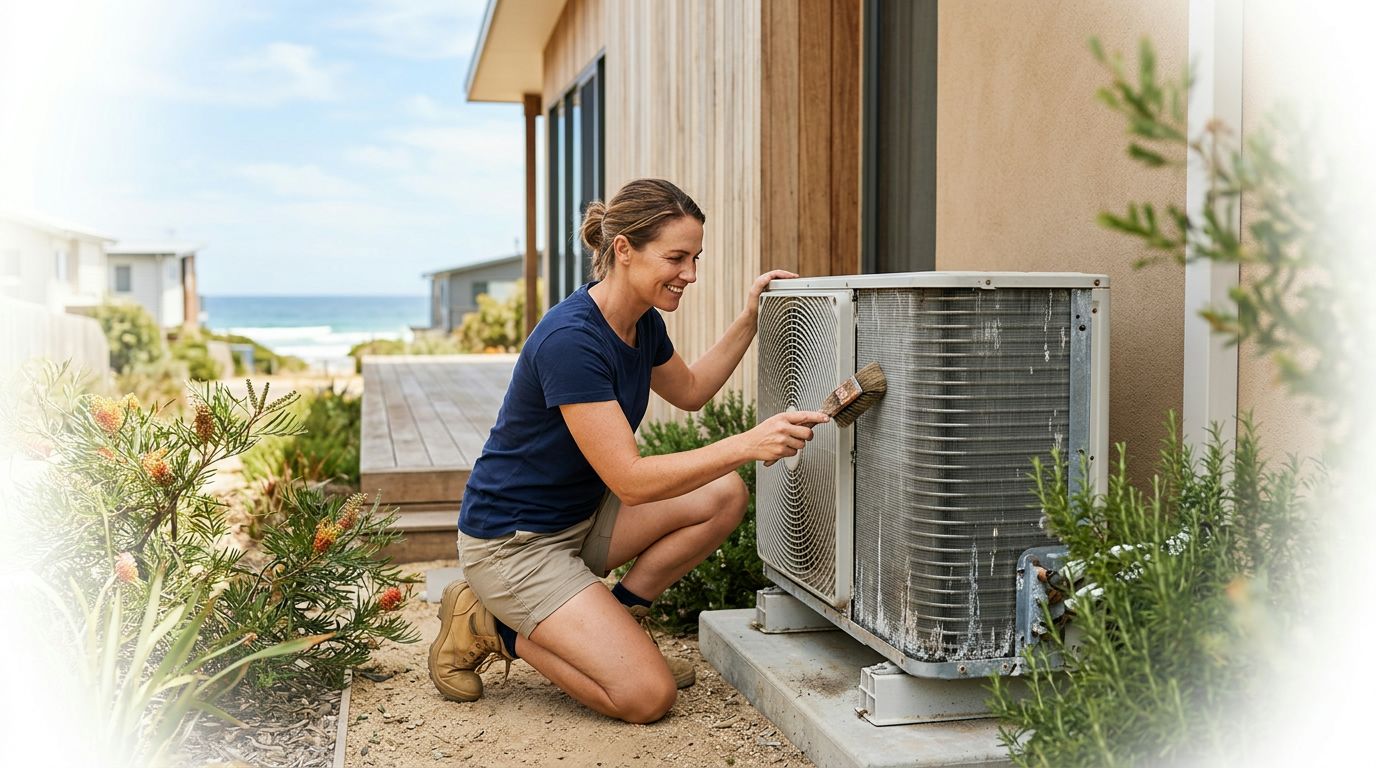
Why Salty Air and Air Conditioners Are a Bad Combination
If you own a home in Mosman or Balmain and your outdoor air conditioning unit is starting to look rough after a few Sydney summers, salty air is almost certainly the culprit. Sodium chloride carried in sea spray and humid coastal air settles on metal surfaces and quietly eats away at them, season after season.
Most homeowners assume this is purely a beachfront issue, but salt-laden air can travel up to 80km inland, putting suburbs well beyond the immediate shoreline firmly in the risk zone.
This article covers how salt causes damage at a component level, the warning signs to watch for on your own unit, the protective measures that genuinely work, and how to choose a coastal-rated air conditioner if you're due for a replacement.
Key takeaways
- Salty air air conditioner corrosion can occur up to 80km inland from the coast.
- Salt triggers electrochemical reactions that accelerate metal oxidation and component failure.
- Regular professional maintenance and corrosion-inhibiting coatings significantly extend system lifespan.
How Salt Air Corrodes Your AC: The Science Behind the Damage
Salt corrosion is not simply rust forming on the outside of your unit. Sodium chloride in coastal air triggers an electrochemical reaction the moment it contacts metal in the presence of moisture. The salt acts as an electrolyte, accelerating the transfer of electrons between metal surfaces and dramatically speeding up oxidation. What might take years to develop in a dry inland suburb can appear within a single summer just a few kilometres from the water.
The practical consequence is that metal components thin out, pit and eventually fail. Condenser fins that start at less than a millimetre thick are particularly vulnerable. Once corrosion takes hold, the fins collapse or fuse together, restricting airflow across the coil. A unit with around 20% fin blockage from salt build-up has to work noticeably harder to shift the same amount of heat, which pushes up your electricity bill and puts extra strain on the compressor. Left unchecked, that compressor will fail prematurely, and a compressor replacement on a split system typically costs more than the unit itself.
The damage is not always visible from the outside either. Salt particles are fine enough to penetrate the outdoor unit casing and reach electrical contacts and circuit boards, where corrosion causes intermittent faults, tripped breakers and eventually complete failure of the control board.
Which Parts of Your AC Are Most Vulnerable?
Four components bear the brunt of salt corrosion on a typical split system or ducted outdoor unit:
- Condenser coils and aluminium fins. These are the thin, closely spaced metal fins wrapped around the outdoor coil. Aluminium is lightweight and conducts heat well, but it is highly susceptible to pitting corrosion from salt. Once pitting starts, the fins lose structural integrity and the coil's heat exchange efficiency drops sharply.
- Outdoor unit casing and mounting brackets. The steel cabinet and the brackets bolted to your wall or slab are in constant outdoor exposure. Without a protective coating, surface rust spreads under paint layers and weakens the structural integrity of the mounting over time, which is a safety concern as much as an aesthetic one.
- Copper refrigerant lines and connections. Copper is relatively corrosion-resistant, but the joints and flare connections where copper meets brass fittings are vulnerable to galvanic corrosion, particularly where salt moisture sits in the gap between two different metals.
- Electrical contacts and circuit boards. Salt particles that reach the internal electrics cause oxidation on terminals and solder joints. This leads to high-resistance connections, intermittent faults and, in advanced cases, short circuits that damage the control board entirely.

Warning Signs That Salt Air Is Already Damaging Your System
The most common warning signs of salt air corrosion on an air conditioner are visible rust or white powdery residue on the outdoor unit, reduced cooling output, unusual rattling sounds, rising electricity bills and refrigerant leaks. These symptoms often appear gradually over one to three years in coastal suburbs, which makes them easy to dismiss until the damage is already serious.
Here is what to look for when you inspect your outdoor unit:
- White or grey powdery residue on the fins or casing. This is aluminium oxide, the byproduct of salt attacking the aluminium condenser fins. It looks like a chalky bloom across the surface of the fins and is one of the earliest visible signs of corrosion taking hold.
- Surface rust on the casing or mounting brackets. Orange-brown rust streaks on the steel cabinet or wall brackets indicate that the protective coating has broken down. Left alone, this rust spreads under the paint and weakens the structural integrity of the mounting.
- Reduced cooling performance despite the unit running normally. If your system is running constantly but struggling to reach the set temperature, corroded and collapsed fins are a likely cause. Restricted airflow across the coil forces the unit to work harder for the same result.
- Unusual rattling or vibrating from the outdoor unit. Corroded mounting brackets lose their grip, and fins that have fused or bent from corrosion can vibrate against the casing. A rattle that was not there six months ago is worth investigating promptly.
- Higher-than-usual electricity bills. A unit fighting through corroded fins draws more power to compensate for reduced heat exchange efficiency. If your bills have crept up without a change in usage habits, the outdoor unit is worth checking.
- Ice forming on the indoor unit or a hissing sound near the refrigerant lines. These are signs of a refrigerant leak. Galvanic corrosion at copper-to-brass joints can cause pinhole leaks that allow refrigerant to escape slowly. Ice on the indoor coil and a faint hissing near the line set are the tell-tale signs.
Coastal corrosion damage is particularly deceptive because each individual symptom can seem minor on its own. A bit of surface rust, slightly higher bills, cooling that is almost right but not quite. By the time the compressor fails, the damage has usually been building for years. For a broader checklist of symptoms to watch for, see our article on 7 signs your split system needs a service.
How to Protect Your Air Conditioner from Salty Air
The four most effective ways to protect an air conditioner from salt air damage are regular professional cleaning, applying a corrosion-inhibiting coil coating, rinsing the outdoor unit with fresh water every four to six weeks and positioning the unit to reduce direct exposure to sea breezes. Used together, these measures can significantly extend the working life of a coastal air conditioner.
- Book a professional clean every 12 months, or more frequently if you are close to the water. A professional service focuses on the outdoor condenser coils, where salt deposits accumulate fastest. A technician will flush the coil with a purpose-formulated coil cleaner, straighten bent fins and inspect for early corrosion damage that is not visible from the outside. AirFlow Australia's professional air conditioning cleaning service includes a full condenser coil clean and a corrosion inspection as standard. Several major manufacturers will void the warranty on a unit if corrosion damage is found and there is no service history to show the unit was maintained. Regular professional servicing protects both your equipment and your warranty.
- Apply a corrosion-inhibiting coil coating to the outdoor unit. Products like Blygold PoluAL or similar fin-coat treatments create a thin polymer barrier between the aluminium fins and the salt-laden air. The coating does not affect heat exchange performance but dramatically slows the rate of corrosion. This treatment is particularly worthwhile on a new unit installed within 500m of the ocean, where unprotected fins can show visible pitting within a single summer. A coating applied at installation and reapplied every few years is one of the most cost-effective protective measures available.
- Rinse the outdoor unit with fresh water every four to six weeks during summer. This is something most homeowners can do themselves. A gentle rinse with a garden hose, directed through the fins from the outside, washes away salt deposits before they have time to react with the aluminium. Avoid high-pressure washers, which can bend the fins and force water into electrical components. A low-pressure rinse takes about five minutes and costs nothing.
- Position the outdoor unit to minimise direct exposure to prevailing sea breezes. This is most relevant at the installation stage, but it is worth reviewing on an existing unit too. Where possible, mount the unit on a wall that faces away from the ocean, or use a fence or screen planting to break the direct line of salt-laden wind. The key constraint is airflow. The unit needs at least 300mm of clear space around the discharge and intake sides, so any screening must not restrict ventilation.
How Often Should Coastal Homes Service Their AC?
Servicing frequency for a coastal air conditioner should be based on how close the unit is to the water. The closer you are, the higher the salt concentration in the air and the faster corrosion progresses.
| Distance from the ocean | Recommended service frequency |
|---|---|
| Within 200m | Every 6 months |
| 200m to 1km | Every 12 months |
| 1km to 5km (coastal suburb) | Every 12 to 18 months |
| Inland (beyond 5km) | Every 1 to 2 years |
For homes in Manly, Bondi, Coogee or Cronulla that sit within a few hundred metres of the beach, twice-yearly servicing is not excessive. It is the single most effective thing you can do to protect your investment. A professional service costs a fraction of what a compressor replacement or full unit swap will set you back if corrosion is left to run its course.
Choosing a Coastal-Rated Air Conditioner: What to Look For
If you are replacing a corroded unit or installing a new system in a coastal suburb, choosing a model with built-in corrosion protection is one of the smartest decisions you can make. Several major manufacturers offer units with hydrophilic or epoxy-coated condenser fins, powder-coated or stainless steel outdoor casings and conformal coatings on circuit boards. These features slow salt corrosion significantly compared to a standard residential unit installed in the same location.
The three brands we most commonly recommend for coastal Sydney homes are Daikin, Mitsubishi Electric and Fujitsu. Each takes a slightly different approach to corrosion protection, and the right choice depends on your distance from the water, your budget and whether you want factory-applied protection or are happy to add a professional coating at installation.
| Brand | Coastal / Corrosion Protection Feature | Standard Warranty | Coastal / Enhanced Warranty |
|---|---|---|---|
| Daikin (Cora Series, e.g. FTXM25WVMA 2.5kW) | Standard aluminium fins; professional Blygold fin-coat treatment available through installers at time of installation | 5 years parts and labour | Verify with Daikin; coating may be a warranty condition within 500m of salt water |
| Mitsubishi Electric (MSZ-AP Series, e.g. MSZ-AP25VGD 2.5kW) | Pre-coated hydrophilic fins as a standard factory feature on outdoor coil | 5 years parts and labour | Verify current coastal warranty terms with Mitsubishi Electric Australia |
| Fujitsu (ASTG Series, e.g. ASTG09KMCA 2.5kW) | Hydrophilic blue-fin coating on outdoor condenser coil as standard | 5 years parts and labour | Verify current coastal warranty terms with Fujitsu General Australia |
The Daikin Cora series is a popular choice for coastal homes, with supply-and-install pricing typically sitting around $1,800 to $2,200 for a 2.5kW unit depending on installation complexity. The key is pairing it with a professional Blygold fin-coat treatment applied at installation, which adds a polymer barrier between the aluminium fins and the salt air from day one. The Mitsubishi Electric MSZ-AP series and Fujitsu ASTG series both include hydrophilic fin coatings as factory-standard features, which makes them strong options if you want protection built in without relying on an aftermarket treatment.
One honest trade-off worth noting: no factory coating or aftermarket treatment eliminates the need for regular maintenance. A coated unit in a beachfront suburb still needs professional servicing every six to 12 months. The coating buys you time and reduces the rate of corrosion, but it does not make the unit immune. Verify exact model specifications, current pricing and warranty conditions with AirFlow Australia before purchasing, as these details can change between production runs.
AirFlow Australia can advise on the right coastal-grade unit for your home's specific location and exposure level. Browse our range of split system air conditioning options to see what we install across Sydney's coastal suburbs.
Frequently Asked Questions
How close to the ocean does an air conditioner need to be before salt air becomes a problem?
Salt air corrosion becomes a meaningful risk for air conditioners within about five kilometres of the coast, and a serious risk within one kilometre. Units installed within 200 metres of the ocean or a harbour can show visible fin corrosion within a single summer if they are unprotected. Salt particles are light enough to travel considerable distances inland, particularly on days with strong onshore winds.
Can I use a standard air conditioner near the beach, or do I need a special coastal model?
A standard residential air conditioner can be installed near the beach, but it will corrode faster than a unit with factory-applied fin coatings or a professional Blygold-type treatment. If you are within 500 metres of salt water, choosing a model with hydrophilic or epoxy-coated fins and pairing it with a corrosion-inhibiting coating at installation is strongly recommended. Some manufacturers also have specific warranty conditions that apply to coastal installations, so check the fine print before you buy.
How often should I rinse my outdoor air conditioning unit if I live near the beach?
A gentle fresh-water rinse every four to six weeks during summer is a practical minimum for homes within one kilometre of the ocean. Use a garden hose at low pressure, directing water through the fins from the outside to flush away salt deposits. Avoid high-pressure washers, which can bend the delicate aluminium fins and force water into electrical components.
Does salt air damage void my air conditioner's warranty?
It can. Several major manufacturers include clauses in their warranty terms that limit or exclude cover for corrosion damage if the unit has not been regularly serviced or if it was installed in a coastal environment without the recommended protective treatment. The safest approach is to keep a professional service record, apply a corrosion-inhibiting coating at installation and confirm the coastal warranty conditions with your installer before the unit goes in.
Protect Your Investment Before the Salt Does the Damage
Salt air is a genuine, ongoing threat to air conditioners in coastal Sydney suburbs. The damage is gradual and cumulative, which makes it easy to ignore until a compressor fails or a control board shorts out and you are facing a repair bill that dwarfs what regular maintenance would have cost. The good news is that the right unit choice, a corrosion-inhibiting coating applied at installation and consistent professional servicing make a significant difference to how long your system lasts.
AirFlow Australia's team services coastal suburbs across Sydney including Mosman, Balmain and Neutral Bay, and we see the full range of salt corrosion damage firsthand. We know what works and what does not in these environments.
If your outdoor unit is showing any of the warning signs covered in this article, or if you are due for a replacement and want advice on the right coastal-grade model for your location, call us on 0423 535 905 to book an air conditioning service or request a free quote for a corrosion-resistant replacement unit.