
What Is the Best Air Con Temperature for Australian Homes?
It's 38°C on the North Shore and your split system is blasting away. You've set it to 18°C because it feels like it should cool the room faster, but your electricity meter is spinning and the room still feels muggy. Sound familiar? The best air con temperature for most Sydney homes sits between 24°C and 26°C in summer and 18°C to 20°C in winter. This range balances genuine comfort with manageable running costs.
That gap between what feels right and what's actually efficient is where most households lose money. This guide covers the ideal settings for every season, explains how each degree shift affects your bill, and gives practical advice for sleeping and working from home in Sydney's variable climate.
Key takeaways
- The best air con temperature for Sydney homes is 24–26°C in summer and 18–20°C in winter.
- Each degree cooler in summer adds roughly 10% to your running costs.
- Modern inverter split systems cool faster at higher set points by modulating compressor speed intelligently.
Ideal Air Con Temperature Settings by Season
The recommended air con temperature range differs significantly between cooling and heating modes, and getting it right can cut your energy bill by 20% or more without sacrificing comfort. For Sydney homes, the sweet spot is 24°C to 26°C for summer cooling and 18°C to 20°C for winter heating. These settings work with your system rather than against it.
| Season | Recommended Range | Most Energy-Efficient Setting |
|---|---|---|
| Summer (Cooling) | 24°C to 26°C | 26°C |
| Winter (Heating) | 18°C to 20°C | 18°C to 19°C |
Best Temperature for Cooling in Summer
For summer cooling, 24°C to 26°C is the comfort range for most Sydney households, with 26°C being the most energy-efficient target. Ergon Energy's widely cited research found that each degree cooler in summer adds roughly 10% to your air conditioning running costs. Dropping from 26°C to 22°C can nearly double what you spend to cool the room.
Setting your unit to 18°C on a 38°C day is one of the most common and costly mistakes Sydney homeowners make. At that setting, the compressor runs continuously at full load trying to bridge a 20-degree gap, which spikes electricity consumption and puts unnecessary wear on the system. You won't cool the room faster. You'll just spend more getting there.
Modern inverter split systems handle this much more intelligently. A unit like the Daikin Cora series (for example, the FTXM25Y 2.5kW) or the Fujitsu ASTG series (such as the ASTG09KMCA 2.5kW) modulates compressor speed continuously to hold your chosen set point. At 26°C, the inverter ramps up hard to pull the room down quickly, then throttles back to a low, efficient hum to maintain that temperature. A higher set point doesn't mean slower cooling. It means smarter cooling with a lower running cost.
Sydney's coastal suburbs and Inner West areas like Newtown and Marrickville also benefit from the humidity factor. Higher relative humidity makes 24°C feel noticeably cooler than the same temperature in drier inland areas, so residents in those suburbs can often set their unit a degree higher than they might expect and still feel comfortable.
Best Temperature for Heating in Winter
For winter heating, 18°C to 20°C is the recommended range for Sydney homes. Many homeowners push their heating up to 24°C or 25°C, which wastes energy, drives up bills and can dry out the air in the room significantly. This is particularly noticeable in older terrace homes in Balmain or Leichhardt where ceiling heights are generous and heat stratifies toward the top of the room.
The good news is that reverse-cycle split systems are exceptionally efficient heaters. A quality unit like the Mitsubishi Electric MSZ-AP series (for example, the MSZ-AP25VGD 2.5kW) can deliver 3 to 4 kW of heat output for every 1 kW of electricity it consumes, thanks to its heat pump operation. That's three to four times more efficient than a standard electric bar heater, which makes the running cost argument for keeping the set point at 18°C to 20°C even stronger.
Setting heating too high also tends to create a secondary problem: the air feels uncomfortably dry, which leads some homeowners to switch their unit to dry mode to compensate. If you're unsure about the difference between those settings, our guide to dry mode vs cool mode explains exactly when each setting is appropriate and how to use them together effectively.
How Temperature Settings Affect Your Energy Bill
Your thermostat setting has a direct and measurable impact on what you pay to run your air conditioner. Based on NSW retail electricity rates of around $0.32 per kWh, a typical 2.5 kW split system running for eight hours a day can cost anywhere from under $1.50 to over $3.00 daily depending on the set point. This difference compounds quickly across a Sydney summer or winter.
The 10% Rule: Why Every Degree Counts
The 10%-per-degree principle is one of the most useful rules of thumb in home energy management. For every degree you lower your cooling set point (or raise your heating set point), your air conditioner's running cost increases by roughly 10%. That sounds modest until you do the maths over a season.
Take a simple example: if running your unit at 24°C costs around $1.20 per day, dropping to 22°C adds approximately $0.24 per day. That's about $7 extra per month. Over a Sydney summer of three to four months, that two-degree difference costs you an additional $21 to $28. Before assuming your unit is inefficient, try raising the cooling set point by one or two degrees and give it a week. Most households find the comfort difference is barely noticeable, but the bill difference is real.
The Fujitsu ASTG series (such as the ASTG09KMCA 2.5kW) is a good example of an inverter system that responds particularly well to higher set-point temperatures. At 26°C, it reaches the target quickly and then drops to a low, efficient holding speed rather than cycling on and off. Non-inverter units bleed money through constant cycling.
| Set Temperature | Mode | Approx. Daily Cost | Approx. Monthly Cost |
|---|---|---|---|
| 26°C | Cooling | $1.00 | $30 |
| 24°C | Cooling | $1.20 | $36 |
| 22°C | Cooling | $1.45 | $43 |
| 18°C | Heating | $0.90 | $27 |
| 20°C | Heating | $1.10 | $33 |
| 22°C | Heating | $1.30 | $39 |
Estimates based on a 2.5 kW inverter split system running eight hours per day at approximately $0.32/kWh (NSW average retail rate). Actual costs vary by home size, insulation quality and outdoor temperature. Inverter units typically run at 40–60% of rated capacity once the set point is reached, so real-world costs are often lower than these figures suggest for non-inverter equivalents.
If your current system struggles to hold temperature efficiently at these set points, it may be worth looking at energy efficient air conditioners with a higher star rating. The running cost savings over three to five years often offset the cost of upgrading.
Temperature Tips for Sleeping, Working From Home and Specific Rooms
A single 'best' temperature doesn't work for every situation in your home. The right set point for a good night's sleep is different from what keeps you focused at a desk, and a north-facing bedroom in a Wahroonga Federation home behaves very differently from a south-facing living room in a Neutral Bay apartment. Matching your set point to the activity and the room makes a bigger difference than most people realise.
Sleeping
Sleep researchers consistently recommend a bedroom temperature of 18°C to 20°C for quality rest. The body's core temperature naturally drops during sleep onset, and a cooler room supports that process. Setting your unit to 24°C or higher in the bedroom may feel comfortable when you first lie down, but it can disrupt deeper sleep stages as the night progresses.
Use your unit's sleep or quiet mode if it has one. Most modern split systems reduce fan speed and allow the set point to drift slightly warmer through the night, which saves energy without waking you up. A timer set to switch the unit off after two to three hours is another practical option for Sydney's milder autumn nights.
Working From Home
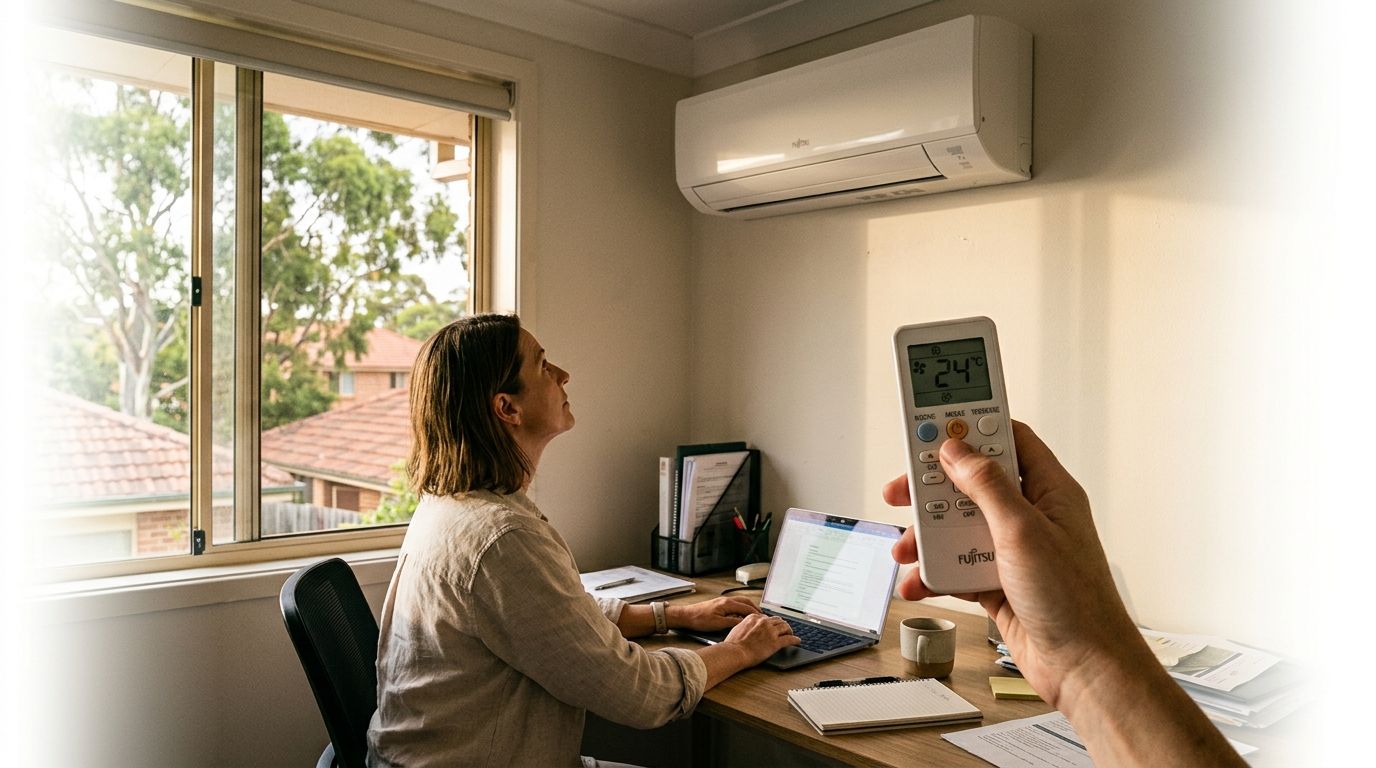
For a home office, 22°C to 24°C is the range that supports sustained focus without the fatigue that comes from a room that's either too warm or too cold. Research into thermal comfort and cognitive performance consistently points to this band as the productivity sweet spot for sedentary desk work.
If your home office faces west, as many do in North Sydney apartments and newer builds across Ryde and Meadowbank, factor in afternoon radiant heat gain. A west-facing room can feel two to three degrees warmer than the thermostat reads by mid-afternoon, so dropping your set point by one to two degrees from around 1pm helps maintain a consistent feel without overcooling the space in the morning.
Rooms With High Sun Exposure
North-facing rooms in older Federation homes across Wahroonga and Gordon absorb significant solar heat through large windows and uninsulated rooflines. The same applies to west-facing apartments in North Sydney and Chatswood. In these spaces, the air conditioner is fighting radiant heat that the thermostat sensor doesn't fully account for, so lowering the set point by one to two degrees compared to a shaded room is a reasonable adjustment rather than a sign that your unit is undersized.
Should You Leave the Air Con On All Day?
The 'leave it on vs switch it off' debate comes up constantly, and the honest answer depends on your home's construction. For well-insulated Sydney homes, the most efficient approach is to pre-cool the space to around 24°C using a timer before you arrive home, then let the unit maintain that temperature. Blasting a hot room from scratch at 3pm on a 35°C day forces the compressor to work at full load for an extended period, which costs more than steady maintenance would have.
For older terrace homes in Balmain or Leichhardt with single-brick walls, minimal ceiling insulation and gaps around original sash windows, the calculation shifts. These homes lose conditioned air quickly, so running the unit continuously at a moderate set point may not be significantly cheaper than switching it off and cooling down again later. If you're unsure which category your home falls into, a professional assessment is the most reliable way to find out.
Most modern split system air conditioning units include programmable timers and weekly scheduling, so you can set pre-cooling or pre-heating to kick in automatically without thinking about it each day. That scheduling function is one of the most underused features on the market and one of the simplest ways to cut your running costs without changing how comfortable your home feels.
When the Right Temperature Setting Isn't Enough
If your air conditioner is struggling to reach or hold its set temperature, the thermostat is rarely the problem. The most common culprits are a clogged filter, low refrigerant, an undersized unit or a system that simply hasn't been serviced in years. AirFlow Australia's technicians regularly arrive at Sydney homes to find units running flat-out at 18°C not because they're broken, but because they're choked with dust and can't move air efficiently.
A blocked filter is the single most overlooked cause of poor cooling and heating performance. When the filter is clogged, airflow across the evaporator coil drops sharply, the unit works harder to compensate and the room never quite reaches the set point. Cleaning or replacing the filter takes about five minutes and can restore performance noticeably. If you've cleaned the filter and the problem persists, the issue is likely deeper inside the system.
Low refrigerant is another common cause, and it's one you can't fix yourself. A system running low on refrigerant loses its ability to transfer heat effectively, which means it runs longer, costs more and still underperforms. If your unit is blowing air that feels only mildly cool on a hot day, that's a strong indicator. For a full list of warning signs, our guide to signs your split system needs a service covers the symptoms worth watching for.
Annual air conditioning service is the most reliable way to catch these issues before they become expensive. A professional check covers refrigerant levels, coil condition, electrical connections and filter status in one visit. If your system hasn't been looked at in the last 12 months, a health check is a sensible first step before assuming you need a new unit. Call AirFlow Australia on 0423 535 905 to book one.
Frequently Asked Questions About Air Con Temperature Settings
What is the most energy-efficient temperature for air conditioning?
The most energy-efficient air con temperature is 26°C for cooling in summer and 18°C for heating in winter. These settings keep your system running at a moderate load rather than working flat-out to bridge a large gap between the indoor and outdoor temperature. Each degree you move away from these targets adds roughly 10% to your running costs.
Is it cheaper to leave the air con on all day or turn it off?
For well-insulated Sydney homes, using a timer to pre-cool or pre-heat the space before you arrive is generally cheaper than leaving the unit running all day. For older homes with poor insulation, such as single-brick terraces in Balmain or Leichhardt, the answer is less clear-cut and depends on how quickly the home loses conditioned air. A programmable timer is the most practical tool for managing this either way.
What temperature should I set my air con to at night?
Set your bedroom air con to 18°C to 20°C for sleeping. The body's core temperature drops naturally during sleep onset, and a cooler room supports that process. Using your unit's sleep or quiet mode allows the fan speed to reduce gradually through the night, which saves energy without disrupting your rest.
Why is my air con not reaching the set temperature?
The most likely causes are a dirty filter restricting airflow, low refrigerant reducing heat transfer capacity, or a unit that's undersized for the room. Setting the thermostat lower won't fix any of these problems. Check and clean the filter first, and if performance doesn't improve, book a service check to assess refrigerant levels and coil condition.
Find Your Perfect Setting and Keep Your System Running at Its Best
The best air con temperature for Sydney homes is 24°C to 26°C for summer cooling and 18°C to 20°C for winter heating. Every degree you move away from those ranges adds roughly 10% to your running costs, and the most efficient system in the world can't compensate for a set point that's working against it. The goal is a temperature your unit can hold comfortably, not one it's constantly chasing.
A well-maintained system makes all the difference here. Clean filters, correct refrigerant levels and annual servicing are what allow a unit to hold its set point efficiently season after season. Without that upkeep, even a quality inverter split system will underperform and cost you more to run.
If you'd like help getting your system back to its best, or you're ready to upgrade to a unit that handles Sydney's climate properly, the AirFlow Australia team is ready to help. Call us on 0423 535 905 or 02 8000 0604 to book a service, request a free installation quote or get straightforward advice on the right system for your home. All installations come backed by a 5-year installation warranty for complete peace of mind.